Showing posts with label children's. Show all posts
Saturday, November 19, 2011
From Saigon to Alabama
Inside Out and Back Again
by Thanhha Lai
National Book Award 2011
In 1975, young Ha and her family are scraping by in Saigon, waiting for her father, a naval officer, to return. When the family learns that South Vietnam will soon fall to the communists, however, Ha's mother makes the difficult choice to flee. Crammed onto a boat with hundreds of other families, Ha and her family decide to go to America, where they are sponsored by a man in Alabama.
While the book is divided into thematic sections -- Saigon, the boat, and America -- the American section is definitely the longest and one of the more emotional sections, as Lai details Ha's attempts to fit in at school and in the community. Aside from a neighbor who happens to be a retired teacher who helps Ha with her English, there are few likeable American characters. It is unclear if this was intentional in order for readers to better sympathize with the Vietnamese protagonists or if it is factual, as Ms. Lai based a number of events on her own childhood in the South.
Given the subject matter, I had expected the book to be far more emotional. Perhaps it is because the verse prevents any major character depth or analysis, but I felt rather disconnected throughout its duration. I'm glad that there is a children's book about the fall of Saigon written through the POV of a Vietnamese child, but I feel like this book, at least, is more focused on America and assimilation. It's a worthy attempt, but it falls short.
Grade: B
Labels:
children's,
historical fiction,
National Book Award,
poetry,
Thanhha Lai
Thursday, November 3, 2011
Mowgli Meets Dracula and the Wolfman
The Graveyard Book
by Neil Gaiman
Newbery Medal 2009, Carnegie Medal 2010
I first read this book back in October of 2009, long before I had this blog. Recently, I was assigned the audiobook version for a children's resources class, hence my post. While I will focus primarily on the plot and characters, I'd also like to speak a little of the book versus the audio version.
In the opening pages, the parents and sister of the main character (a baby boy) are murdered by the Man Jack, while the baby manages to escape to a nearby cemetery where he is promptly adopted by the Owenses, a married couple who died sometime in the 1800's. While the book chronicles the life of the boy (christened Nobody "Bod" Owens) through adolescence and his eventual confrontation with the Man Jack, the manner in which it is written is more akin to a series of vignettes than a traditional novel.
There have been complaints by some that the characters who populate the book, being ghosts, vampires, werewolves, etc., are inappropriate for the young readers at whom the novel is directed. However, it should be pointed out that these characters are all friends, teachers, and mentors to our young protagonist and that the entire work is also modeled upon The Jungle Books, in which a young boy is raised in the jungle by animals. Just as some animals intended Mowgli harm, but the majority looked after him, the majority of the supernatural characters here have Bod's best interests in mind.
As has come to be expected, Mr. Gaiman's writing is a brilliant marriage of Kipling's stories and characters with a modern setting and Mr. Gaiman's trademark wit. Regarding the audiobook, which is narrated by Mr. Gaiman, it has some nice additions, such as performances by Bela Fleck, and being read by the author himself provides perhaps the truest reading of the material. I personally prefer reading the book myself, however, as I found my attention wandering while listening to the audiobook for too long.
I read a year or two ago that a book focusing on Silas, Bod's mentor and the Bagheera character, was in the works, but I've not heard anything more about it. While I would certainly enjoy returning to Bod's world, this installment works perfectly on its own.
Grade: A
Labels:
Carnegie Medal,
children's,
fantasy,
Neil Gaiman,
Newbery Medal
Monday, October 31, 2011
Two Transmedia Titles
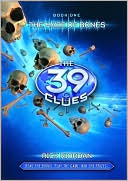
The Maze of Bones
by Rick Riordan
Similar to the set-up of The Westing Game, in which various people must solve a mystery in order to be chosen as the recipient of a fortune bequeathed in a will, here the members of the Cahill family are given the option of keeping $1,000,000 or forfeiting it in order to participate in the quest. Our protagonists, the orphan siblings Amy and Dan reluctantly decide to participate after deciding that their grandmother, the writer of the will, would have wanted them to do so.
The siblings soon find themselves the targets of their wealthy and powerful relatives, who all assume the kids have been given priviledged information by their grandmother before her death. Along with their au pair, they attempt to unravel the first clue before the others, which happens to center on Ben Franklin this volume.
While the first volume of The 39 Clues series provides entertaining fluff, the characters are all pretty static and stereotypical, from the Russian spy to the teen celebrity. Given that this is a corporate series with various authors, I expect that plot will remain more important than characterization for the duration.
The series has a website tie-in where kids can participate in the quest and solve clues, but a good deal of this is dependent upon the cards that come with the books (and are sold in additional packets). The books stand alone, and it really seems to me that this marketing ploy was an afterthought.
Grade: B-
Skeleton Creek
by Patrick Carman
In the first installment of the series, readers are introduced to high school students Ryan and Sarah, best friends whose parents have forbidden them from seeing each other after Ryan is injured while the two investigate a supposedly haunted mining dredge. Sarah becomes increasingly obsessed with the site, forming conspiracy theories about the town and its supposed secret societies. The two continue to communicate via e-mail and by the installment's end, Ryan and Sarah are investigating the site once again.
Presented as found evidence in the form of Ryan's journal, the best element of the series is the innovative use of video to tell the parts of the story from Sarah's perspective. The argument can be made that for the majority of the book it's not absolutely necessary to watch these clips, but the final scene is only available through the video component, so I recommend navigating between the text and videos as intended.
Again, the characters here are pretty flat. The mystery of the dredge is what drives the book forward, and the book would be pretty forgettable were it not for the video component.
Grade: C
Labels:
action,
children's,
mystery,
Patrick Carman,
Rick Riordan,
transmedia
Friday, October 28, 2011
Good Kids Can Have Bad Records
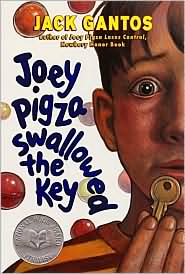
Joey Pigza Swallowed the Key
by Jack Gantos
National Book Award finalist 1998
Joey Pigza is a good kid. This is apparent to his teachers, but often obscured by his uncontrolled ADHD. When he accidentally injures another student, however, the school can no longer stand idly by; Joey must be sent to the local special education center until he can keep his disorder properly checked.
While some of the handling of ADHD is a bit dated now (given that there are more treatment options than Ritalin), this is still a fabulous book on the issue. Mr. Gantos writes in a first-person, almost stream-of-consciousness style to emulate Joey's thought processes, which provides great insight into the mind of a young boy with this disorder. Joey himself also learns tolerance for those with mental and physical disabilities through his interactions with other children at the special education center, befriending a boy with malformed arms and another who is developmentally disabled.
Those interested in continuing to follow Joey's exploits should check out the other books in the series, starting with the next installment, Joey Pigza Loses Control.
Grade: A-
by Jack Gantos
National Book Award finalist 1998
Joey Pigza is a good kid. This is apparent to his teachers, but often obscured by his uncontrolled ADHD. When he accidentally injures another student, however, the school can no longer stand idly by; Joey must be sent to the local special education center until he can keep his disorder properly checked.
While some of the handling of ADHD is a bit dated now (given that there are more treatment options than Ritalin), this is still a fabulous book on the issue. Mr. Gantos writes in a first-person, almost stream-of-consciousness style to emulate Joey's thought processes, which provides great insight into the mind of a young boy with this disorder. Joey himself also learns tolerance for those with mental and physical disabilities through his interactions with other children at the special education center, befriending a boy with malformed arms and another who is developmentally disabled.
Those interested in continuing to follow Joey's exploits should check out the other books in the series, starting with the next installment, Joey Pigza Loses Control.
Grade: A-
Labels:
children's,
Jack Gantos,
National Book Award,
slice-of-life
Sunday, October 9, 2011
The Monsters We Make
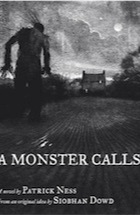
A Monster Calls
by Patrick Ness
Thirteen year-old Conor's mother is dying from cancer, though neither he nor his mum will admit this. His grades in school are slipping, but the teachers give him a pass, ignoring him for the most part, as do the other students, with the exception of a few bullies. His father is in America with a new wife and baby, and his uppity grandmother is coming to stay with them. Conor wonders how his life could possibly get any worse.
Haunted by nightmares each night, Conor isn't terribly surprised when a yew tree in his yard springs to life and threatens to devour him if Conor doesn't tell him his own story after the yew tree finishes telling three of his own. Suspecting it's a dream at first, Conor awakes the next morning to find piles of leaves and berries scattered on the floor of his bedroom.
Mr. Ness is a fabulous writer, and here he shows that he is just as capable of writing a compelling story for middle grade readers as he is for teens. Each of the monster's stories parallels an event in Conor's life, though the outcome of each tale is often far different from what he (and readers) might expect. More sophisticated readers will pick up on the extended metaphor represented by the monster sooner than the final reveal, yet that doesn't weaken the story, as Mr. Ness crafts a very emotional climax.
Accompanying the story, which was written from an idea by the late Siobhan Dowd, are brilliant illustrations by Jim Kay, who manages to capture the emotions of the book perfectly.
I honestly cannot recommend this book enough. I have difficulty empathizing with real people, let alone fictional ones, but the writing here is just so good that even I had my heart wrenched by the end. I will be shocked if this isn't at least short-listed for the Newbery this year.
Grade: A+
by Patrick Ness
Thirteen year-old Conor's mother is dying from cancer, though neither he nor his mum will admit this. His grades in school are slipping, but the teachers give him a pass, ignoring him for the most part, as do the other students, with the exception of a few bullies. His father is in America with a new wife and baby, and his uppity grandmother is coming to stay with them. Conor wonders how his life could possibly get any worse.
Haunted by nightmares each night, Conor isn't terribly surprised when a yew tree in his yard springs to life and threatens to devour him if Conor doesn't tell him his own story after the yew tree finishes telling three of his own. Suspecting it's a dream at first, Conor awakes the next morning to find piles of leaves and berries scattered on the floor of his bedroom.
Mr. Ness is a fabulous writer, and here he shows that he is just as capable of writing a compelling story for middle grade readers as he is for teens. Each of the monster's stories parallels an event in Conor's life, though the outcome of each tale is often far different from what he (and readers) might expect. More sophisticated readers will pick up on the extended metaphor represented by the monster sooner than the final reveal, yet that doesn't weaken the story, as Mr. Ness crafts a very emotional climax.
Accompanying the story, which was written from an idea by the late Siobhan Dowd, are brilliant illustrations by Jim Kay, who manages to capture the emotions of the book perfectly.
I honestly cannot recommend this book enough. I have difficulty empathizing with real people, let alone fictional ones, but the writing here is just so good that even I had my heart wrenched by the end. I will be shocked if this isn't at least short-listed for the Newbery this year.
Grade: A+
Friday, October 7, 2011
A Child's View of Afghanistan
Note: I am currently enrolled in a children's resource class in my library program, and this past week we were discussing the promotion of global awareness through materials, including The Breadwinner. I generally try to keep my blog focused on the newest releases, but I also plan to write about any novels published in the last decade that are assigned in my classes. Occassionally, I might also write about older books if they're relatively obscure or recently republished.
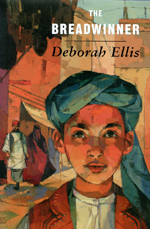
The Breadwinner
by Deborah Ellis
Middle East Book Award 2002
Written in 2000 (and hence pre-9/11), The Breadwinner tells the story of eleven year-old Parvana, a girl growing up in an Afghanistan governed by the Taliban. Before the takeover by the Taliban, her mother was a journalist and her father a teacher. The family lived in a large house, owned a television, and sent their daughters to school. But with the regime change, women were forbidden to work or attend school. The numerous bombings have forced the family from their comfortable home into a one-room apartment in Kabul, and Parvana's father sells his services as a letter-writer or reader in the marketplace.
A few chapters into the book, Parvana's father is arrested. The only reason given is that he was educated in England. With the only male in the family being Parvana's two year-old brother, Ali, Parvana's mother decides that Parvana must disguise herself as a boy in order to support the family until her father's release from prison.
The reason this book seems to be admired is likely because it's one of few books for young readers to detail events in Afghanistan under the Taliban. The writing here is very straightforward, introducing the reader to the culture through the narrative, rather than in lengthy explanations. A short glossary in the back also helps to define some of the foreign words, such as burqa and karachi. While most children reading The Breadwinner are probably unfamiliar with Afghanistan outside of what they might hear on the news, Parvana's presentation as a normal kid will enable them to empathize with her struggle.
Interestingly, Islam is almost entirely absent from the narrative. I'm not sure if the intent here was to prevent the demonization of the religion, though, given when the book was written. Perhaps, instead Ms. Ellis simply didn't want the narrative to become mired in complex explanations of Islamic practices.
Given that Ms. Ellis only spent a few weeks in Afghanistan doing research before writing this novel, some people will complain that it lacks an authentic voice. The issue of authenticity is a complex one, and I will not get into it here. If you are interested in this issue, I highly recommend Malinda Lo's blog post. I will point out, however, that a very similar (albeit more depressing story) is told in the Afghan film Osama, so Ms. Ellis can't be totally off-base.
Grade: B+
The Breadwinner
by Deborah Ellis
Middle East Book Award 2002
Written in 2000 (and hence pre-9/11), The Breadwinner tells the story of eleven year-old Parvana, a girl growing up in an Afghanistan governed by the Taliban. Before the takeover by the Taliban, her mother was a journalist and her father a teacher. The family lived in a large house, owned a television, and sent their daughters to school. But with the regime change, women were forbidden to work or attend school. The numerous bombings have forced the family from their comfortable home into a one-room apartment in Kabul, and Parvana's father sells his services as a letter-writer or reader in the marketplace.
A few chapters into the book, Parvana's father is arrested. The only reason given is that he was educated in England. With the only male in the family being Parvana's two year-old brother, Ali, Parvana's mother decides that Parvana must disguise herself as a boy in order to support the family until her father's release from prison.
The reason this book seems to be admired is likely because it's one of few books for young readers to detail events in Afghanistan under the Taliban. The writing here is very straightforward, introducing the reader to the culture through the narrative, rather than in lengthy explanations. A short glossary in the back also helps to define some of the foreign words, such as burqa and karachi. While most children reading The Breadwinner are probably unfamiliar with Afghanistan outside of what they might hear on the news, Parvana's presentation as a normal kid will enable them to empathize with her struggle.
Interestingly, Islam is almost entirely absent from the narrative. I'm not sure if the intent here was to prevent the demonization of the religion, though, given when the book was written. Perhaps, instead Ms. Ellis simply didn't want the narrative to become mired in complex explanations of Islamic practices.
Given that Ms. Ellis only spent a few weeks in Afghanistan doing research before writing this novel, some people will complain that it lacks an authentic voice. The issue of authenticity is a complex one, and I will not get into it here. If you are interested in this issue, I highly recommend Malinda Lo's blog post. I will point out, however, that a very similar (albeit more depressing story) is told in the Afghan film Osama, so Ms. Ellis can't be totally off-base.
Grade: B+
Friday, September 23, 2011
New Town, New Possibilities
Okay for Now
by Gary D. Schmidt
National Book Award finalist 2011
The late 60's were a difficult time in which to grow up. Civil rights, the Vietnam War, the assassination of Robert Kennedy...These all made it increasingly difficult to navigate through childhood and adolescence. For Mr. Schmidt's protagonist, Doug Swieteck, add in being the new kid in town, and having an alcoholic father and a brother newly returned from the war. Life is far from easy for Doug.
After a local store is robbed (and the younger of Doug's two older brothers is suspected), Doug is either treated with contempt or ignored completely by his fellow classmates, teachers, and townspeople. The only people who give him a chance are Mr. Powell, the local librarian, and Lil Spicer, the daughter of the local grocer for whom Doug works as a delivery boy. Throughout the book, Doug's moods fluctuate wildly, depending on how he's being treated, which I found to be extremely realistic.
The other major story thread throughout the book concerns a copy of Audobon's bird prints, which are being auctioned off one by one to fund the library. As Doug learns how to draw with Mr. Powell each Saturday, copying the Audobon prints, he gradually becomes attached to the pieces and begins a crusade to return the sold prints to the library. In an age where government funding of libraries is being significantly decreased, as law-makers question the role of libraries in this digital age, it was wonderful to see Mr. Schmidt portray the library as a place of learning, and also for him to promote advocacy.
What I was probably most impressed with was Mr. Schmidt's ability to convey a broad range of emotions through simple text. Since our protagonist begins the book as an illiterate, the sentences are succinct and usually devoid of adjectives, yet they never seem to condescend to the intended audience.
There's a lot of buzz about this book at present, and a good many people are predicting a Newbery. I haven't read the other books that people are predicting will be nominated, so I can't say for certain if Okay for Now will win, but I can say that it's well worth a look.
Grade: A
P.S. I still don't know why the cover depicts a boy with a paper bag over his head.
Sunday, March 27, 2011
The Original Toy Story

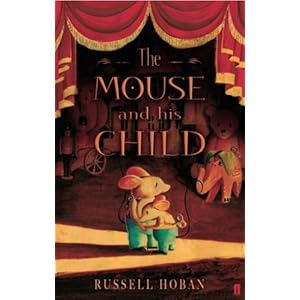
The Mouse and His Child
by Russell Hoban
Out of print until 2001, Russell Hoban's novel for children is not something for everyone. While the themes presented are universal, the manner in which they are presented is often too dark for the intended audience. I certainly appreciate authors who don't over-simplify their writing for child audiences, but I really feel that this particular work is better appreciated by the adults reading to the children.
The basic premise concerns a pair of clockwork mice. When wound, the father lifts the child mouse in his arms and twirls him about. Things go well for the mice for only the first chapter, at which point they are sold, and later broken, resulting in their placement in the trash. From there, the novel keeps a generally gloomy tone while the mice enter the employment of Manny Rat, who they are able to escape but who remains trailing them for the majority of the book, hoping to destroy them.
Along their travels, the mice encounter many interesting characters, including an oracular frog; an experimental theatre troupe consisting of two crows, a parrot, and a rabbit; a philosophical turtle; and several fellow broken toys from the same shop. However, this being a plot-driven novel, the space of a chapter is used to introduce the next group of characters or setting that will aid the two mice in their journey toward freedom and self-winding. Thus, very little time is devoted to character development. I should have liked to have spent more time with the characters, even if it meant being introduced to fewer of them, should it have meant that I'd have a better understanding of those characters. The majority of the characters are very one-dimensional, with the exception of Manny Rat, who I feel is the only dynamic character in the work.
While an enjoyable read for adults, I think children might be bored by this work. That's not to say that it's slow or that nothing happens; quite the contrary is true. However, much of the humour and the philosophy would simply go over children's heads.
Despite its flaws, I am glad that The Mouse and His Child is back in print, and I hope that it will find its audience.
Grade: B
Thursday, March 10, 2011
The Dream-makers

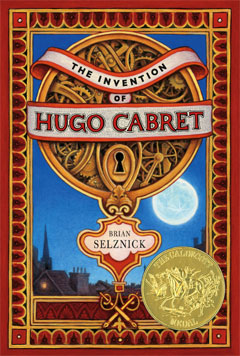
The Invention of Hugo Cabret
by Brian Selznick
Caldecott Medal 2008, National Book Award finalist 2007
Having wanted to read this book for a while after its release, I finally stumbled upon my chance last month at book club. One of my associates there had brought her copy to the club, hoping to spark interest in the upcoming film adaptation (directed by Martin Scorsese!) to be released this fall. Perhaps because I was sitting next to her, or perhaps because I was the first to speak of an interest in the book, I was able to borrow it.
Although the book is over 500 pages long, it's a graphic novel/prose hybrid, consisting of over 200 illustrations, so it's a fairly quick read. Being a children's novel, the prose is relatively simple, as well. Nevertheless, Brian Selznick's gorgeous illustrations are far more descriptive than any prose might have been, as it would have been difficult to truly convey the dreamlike quality of a number of scenes, especially those involving Papa Georges's pictures.
The plot at its most basic tells the story of a young boy, Hugo Cabret, who is living in a train station in Paris. His father, a clockmaker, died recently in a fire, and his uncle has disappeared. Everyday, Hugo tends to the clocks in the station so no one will realize his uncle has disappeared. Hugo also keeps an automaton in his room, as his father had been working on it prior to his death and Hugo hopes to repair the machine.
After Hugo is caught trying to steal a wind-up toy, his father's notebook pertaining to the automaton is confiscated by the old toy-seller, Papa Georges, but the man agrees to return it if Hugo works for him. As time passes, Hugo begins to uncover not only the secrets of the automaton, but of the strange old toy-seller.
Although the plot is fairly straightforward, The Invention of Hugo Cabret is a truly magical work. Why? Well, for me, it must be because at its core the book is about cinema, the people who create it, and the people who love it. And cinema is a world of dreams. It certainly helps that I am a terrible film geek and quite fond of early silent cinema, which is featured prominently in this book. However, I feel that anyone with a dream will adore this work.
Grade: A
Monday, September 13, 2010
The Dark Is Rising

The Dark Is Rising Cycle
by Susan Cooper
Consisting of: Over Seal, Under Stone; The Dark Is Rising; Greenwitch; The Grey King; and Silver on the Tree
Newbery Honor 1974 (The Dark Is Rising); Newbery Medal 1976 (The Grey King)
While this series had been recommended to me before, I finally was able to read it when it was chosen as my book club's July selection. Unfortunately, my apartment flooded the weekend right before the meeting, damaging the last three books, which I had borrowed from a friend, and I only just got around to finishing all of them a few days ago.
Overall, I found the series to be well-written, probably more so than other children's books of its time, as Cooper never simplified her writing or condescended to her audience, as some children's authors are wont to do. I must admit, though, that the first and final installments are probably the weakest of the cycle, as they don't seem to have the same human element or the sense of urgency that is present in the other three books.
In the first book of the series, Over Sea, Under Stone, we are introduced to three siblings on holiday in Cornwall and their eccentric "uncle" (in reality, a family friend, not a blood relation). The pace is a bit slow at first, and even after the quest for the Grail had begun, I don't believe my interest was firmly held until the appearance of the sinister vicar and his henchmen. I would say the last third or so of the book is captivating, but the rest is rather dull, and I can attest that some children to whom I read the opening chapter found it to be such.
The rest of the novels in the series beginning with The Dark Is Rising follow the protagonist Will Stanton, last of the Old Ones, though the Drew children do make an appearance in the third and final books, respectively. It is on Will's eleventh birthday that he discovers he is the last of the Old Ones, and we as readers are meant to learn about the Old Ones and their abilities through him. Unfortunately, Cooper explains very little about the origin of the Old Ones, or what they truly are, which is something that annoyed me while I completed the series. It is also never revealed why Will is the last, or why the Dark has chosen now to make its final stand.
The second through fourth books follow Will and his companions (Merriman, the Drews, and a Welsh boy named Bran) as they search for various artifacts(a harp, a sword, the Grail) that will prevent the Dark from rising. While the action should culminate in the final installment, I found it to be rather anti-climatic, and aside from the personal struggle of a Welshman with whom Will and Bran are acquainted, there was very little tension or emotional impact.
While I would recommend The Prydain Chronicles before The Dark Is Rising Cycle to anyone interested in Welsh inspired fantasy, the series was still intriguing and well-written, even if more exposition could have been given at times. Having read Alexander's work countless times since childhood, I have to admit I still cry at the end of The High King each time I read it, so let that be a testament to his ability to write lovable characters as opposed to Cooper, whose work is much more cerebral.
Series Grade: B
Subscribe to:
Posts (Atom)