Showing posts with label slice-of-life. Show all posts

Sunday, January 15, 2012

2012 Week 1

I realize this is a week late. Apparently, my school reading is going to be a bit more time-consuming than expected this semester. I'll try to do better about posting over the weekend, but no guarantees.

Title: Hatchet
Author: Gary Paulsen
Publishing Date: 1987
Reason Read: required for YA Resources (previously read in 6th grade)
Awards: Newbery Honor 1988


I remember reading Hatchet for my 6th grade English class and hating it, so when it was on the syllabus for my YA Resources class, I cringed a bit, but decided that as an adult maybe I'd better enjoy the book. I was wrong.

The story of Brian, a thirteen year old who survives a plane crash after the pilot of the single-engine plane has a heart attack, has the potential to be captivating, but not enough details of Brian's civilian life are given. All we are told is that his parents are divorced, and Brian unwittingly was privy to the reason why: his mother's illicit affair. Additionally, the writing is extremely repetitive, using the same words and phrasing ad nauseum to the point where I questioned if Mr. Paulsen owned a thesaurus. I understand that the writing is meant to mimic Brian's thoughts, but I'd like to think that even a teenager lost in the wilderness is a bit more sophisticated than this.

Grade: C

Title: Annie on My Mind
Author: Nancy Garden
Publishing Date: 1982
Reason Read: required reading for YA Resources
Awards: N/A


The quintessential lesbian romance novel for young adults, Annie on My Mind tells the story of two New York girls, Annie and Liza, who have a chance meeting at the Metropolitan Museum of Art. The girls quickly become best friends, and the relationship evolves into something more.

Although this novel was written thirty years ago, it is still as poignant and believable today. While Annie has acknowledged that she is gay for some time, Liza's feelings are frightening and new, and she struggles to come to terms with them, as so many others do. And on top of the main romance plot, there is a major plot point involving two teachers at Liza's school who are lesbians and how the school administration reacts to this. While the acceptance of gays has certainly made strides since 1982, the events that unfold in this novel are still extremely plausible, especially in more conservative parts of the country. Highly recommended for any girl questioning her sexuality.

Grade: A

Title: Weetzie Bat
Author: Francesca Lia Block
Publishing Date: 1989
Reason Read: required reading for YA Resources
Awards: Phoenix Award 2009


Despite being only slightly longer than 100 pages, Weetzie Bat manages to cram non-traditional families, gay relationships, and AIDS in its plot without weakening it. Often described as a pop fairy tale, the story follows teenage Weetzie, her friend Dirk, and the life they build through the results of three wishes Weetzie makes via a genie in a magic lamp. I suppose it's a bit precious, but the writing is so ethereal and poetic, I found myself easily sucked into the story. My only real complaint is that more time is spent on surface details instead of building really deep characters, but that goes along with the fairy tale concept, as do the bizarre names (i.e. My Secret Agent Lover Man).

Grade: A-

Title: Monster
Author: Walter Dean Myers
Publishing Date: 1999
Reason Read: required reading for YA Resources
Awards: National Book Award finalist 1999, Printz Award 2000, Coretta Scott King Honor 2000


Written as a screenplay by the main character, Steven Harmon, Monster is a courtroom drama concerning a murder trial of a convenience store owner in New York City. While we are told that Steve served as a look-out of sorts, checking to see that no customers were in the store prior to the botched robbery, throughout the course of the trial, the defense tries to prove his innocence and save Steve from a life behind bars. A number of witnesses are criminals themselves, somewhat discrediting the case of the prosecution. And the entire trial both the jury and we the readers are left wondering if Steve is really innocent.

Given Steve's penchant for filmmaking, the screenplay concept is a nice touch. Had Mr. Myers chosen to write in a traditional format, the story easily could have become bogged down with legal jargon, but as a quick-moving screenplay, such terminology is dealt with much more easily. That the format fits the character so well is a credit to the author.

Grade: A

Title: The Perks of Being a Wallflower
Author: Stephen Chbosky
Publishing Date: 1999
Reason Read: required reading for YA Resources (previously read senior year of high school)
Awards: N/A


Maybe this was just something we did at my high school, but I remember reading Perks in my senior year and passing the copy around to people and having them leave comments in the margins. My own copy was just between my best friend (now husband) and myself, but I had friends who also did this with larger groups of friends. I think the epistolary format and confessional tone of the letters is conducive to this.

I think I'm a bit biased toward this book, not only because of how nostalgic it makes me feel, having grown up in the 90's and come of age soon after the millennium, but also because the book is set in the Greater Pittsburgh metro area. All the places that are mentioned in this book are familiar to me, so it ends up having a special place in my ya collection.

Despite this personal connection to Mr. Chbosky's novel, the issues presented, including homosexuality, teen pregnancy, and abuse are rather universal issues faced by teenagers everywhere, which is why it's such an appealing book. I truly feel that it's my generation's Catcher in the Rye.

Grade: A

Title: Gossip Girl
Author: Cecily von Ziegesar
Publishing Date: 2002
Reason Read: required reading for YA Resources
Awards: N/A


By far the worst book I've read in some time, Gossip Girl is about as mindless as I expected it to be. And while the writing is decent, at least if one likes the style used in gossip columns, what really irritated me was that the characters are almost described in terms of what brand-name they are wearing. If one has no concept of what a certain Prada dress looks like, he'll have little idea what to visualize.

Even worse than the lack of poetic description is the sheer lack of positive characters in the main cast. Nearly all of the major characters drink, smoke, and do recreational drugs. The only girl at the school that I can tolerate is the artistic misfit, Vanessa, but aside from attending a concert with the flighty Serena, she's a peripheral character at best.

I'm glad that these books are getting teens reading, I suppose, but there's so much wrong with them that I really worry about the negative influence the books could potentially have on young readers.

Grade: C-

Monday, January 2, 2012

New Year, New Format: 2011 Week 52

Given the amount of books that I read within a month, I often find that I simply don't have time to stop and write about all of them. So, rather than writing lengthy entries on the newest releases, I've decided to use a new format this year, writing a weekly entry with short reviews of all the middle grade and ya books I've read in a week. Posts will typically go up on Saturday or Sunday.

Nearly all of the books in this week's post were required for an upcoming class. Future weeks should be more of a mix of required and leisure reading; we were assigned 15 books to read by the first day of this particular class, but subsequent weeks have no more than three assigned.

Week 52

Title: The Ruins of Gorlan (Book 1 in the Ranger's Apprentice series)
Author: John Flanagan
Publishing Date: 2004/Australia; 2005/US
Reason Read: required for YA Resources
Awards:Aurealis Award for Best Children's Novel short list 2004


My older brother, who has recently started reading ya novels, had actually recommended this series to me over the summer, so I was glad to see it on the required reading list. Telling the story of an orphaned boy who becomes an apprentice to a ranger (think of the D&D class or Aragorn), The Ruins of Gorlan bridges the gap between The Prydain Chronicles and The Lord of the Rings, with a brisk enough pace to hold the attention of reluctant readers and enough action to satisfy them, as well. The story may be a bit cliche, but the characters are likeable and the writing above-average. While the first installment felt resolved, there are enough loose threads to warrant looking at the next volume.

Grade: B

Title: The Burning Bridge (Book 2 in the Ranger's Apprentice series
Author: John Flanagan
Publishing Date: 2005/Australia; 2006/US
Reason Read: I enjoyed the first book and wanted to see how the series would continue -- I plan on reading the first four books as of now
Awards: N/A


Within the first installment, the over-arching plot involving Morgarath was not resolved. This volume focuses on the impending battle with Morgarath and his minions. Will and his friend Horace are the protagonists here, along with a new character named Evelyn who they encounter on their journey. Both boys have an opportunity to shine, Will with his wits and Horace with his sword. Much of the same is present in this second book of the series, which ends unresolved (at least where Will is concerned). Not as strong as the first installment, but I can see why it remains popular.

Grade: B-

Title: Seventeenth Summer
Author: Maureen Daly
Publishing Date: 1942
Reason Read: required for YA Resources
Awards: N/A


Often considered one of the first young adult novels, Seventeenth Summer was actually written when the author herself was seventeen. The story is rather generic, concerning the first love of a girl about to leave home to attend college. At first, I found it difficult to read, as the dialogue is so trite and corny, but eventually its 40's charm grew on me. It's certainly dated and not for everyone (especially readers accustomed to today's steamy teen romances), but it's fluffy and cute -- perfect for someone who enjoys retro romance.

Grade: B-

Title: The Catcher in the Rye
Author: J.D. Salinger
Publishing Date: 1951
Reason Read: required for YA Resources (previously read junior year of high school)
Awards: Modern Library's 100 Best English-language Novels of the 20th Century


This book needs little introduction, as it's read in high school classrooms all over the country. I never really stopped to consider it as a ya novel before, and I still question that label, despite Holden's age and the issues he deals with in the novel, as I don't think Mr. Salinger's intention was to write for a teenage audience, but a universal audience. Despite its age, The Catcher in the Rye holds up rather well, although like Ms. Daly's book, some of the dialogue does seem a bit dated. I think I appreciated the book more the second time around, though.

Grade: A-

Title: The Outsiders
Author: S.E. Hinton
Publishing Date: 1967
Reason Read: required for YA Resources
Awards: N/A


Another example of early ya written by a teenager, The Outsiders is a bleak account of a band of greasers and the trouble that ensues when one of them kills a rich kid in self-defense. While on the lam, the killer saves a group of children from a burning building and becomes a hero, though gravely injured himself. The kids from the wrong side of the tracks are presented as victims of circumstance here, enabling readers to empathize with them, despite their background, which was rather ground-breaking at the time. I can definitely see why so many high schools require this to be read, as it's brilliantly written and remains poigant today.

Grade: A

Title: The Chocolate War
Author: Robert Cormier
Publishing Date: 1974
Reason Read: required for YA Resources
Awards: N/A


A realistic, albeit brutal, portrayal of the mob mentality present in high schools, The Chocolate War concerns a secret society at a boys' prep school and a freshman who refuses to follow their orders to participate in a chocolate fundraiser. Mr. Cormier's attention to gritty detail helps this work to stand out, although the ending left me cold, as the antagonists receive no form of punishment and the acting headmaster seems pleased with the lawless behaviour of the secret society. Perhaps I'm being too idealistic, but I would have preferred a more satisfying conclusion.

Grade: A-

Title: Forever
Author: Judy Blume
Publishing Date: 1975
Reason Read: required for YA Resources
Awards: N/A


One of the first ya novels to frankly discuss teenage sexuality, Forever concerns the relationship between two high school seniors, including their decision to engage in sex. It's a breezy read with relatively accurate portrayals of teenage love, although I question whether a girl would actually refer to a boyfriend's member by a silly name like Ralph and the parents seem a bit too open to the idea of their teenage daughter having sex. These details aside, it tackles not just sexuality itself, but the consequences that come from it, as well as the difficult question of what to do when a relationship ends.

Grade: B+

Friday, October 28, 2011

Good Kids Can Have Bad Records

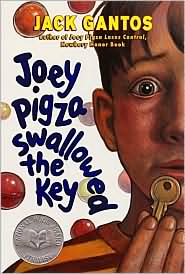
Joey Pigza Swallowed the Key
by Jack Gantos
National Book Award finalist 1998

Joey Pigza is a good kid. This is apparent to his teachers, but often obscured by his uncontrolled ADHD. When he accidentally injures another student, however, the school can no longer stand idly by; Joey must be sent to the local special education center until he can keep his disorder properly checked.

While some of the handling of ADHD is a bit dated now (given that there are more treatment options than Ritalin), this is still a fabulous book on the issue. Mr. Gantos writes in a first-person, almost stream-of-consciousness style to emulate Joey's thought processes, which provides great insight into the mind of a young boy with this disorder. Joey himself also learns tolerance for those with mental and physical disabilities through his interactions with other children at the special education center, befriending a boy with malformed arms and another who is developmentally disabled.

Those interested in continuing to follow Joey's exploits should check out the other books in the series, starting with the next installment, Joey Pigza Loses Control.

Grade: A-

Sunday, October 9, 2011

The Monsters We Make

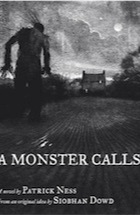
A Monster Calls
by Patrick Ness

Thirteen year-old Conor's mother is dying from cancer, though neither he nor his mum will admit this. His grades in school are slipping, but the teachers give him a pass, ignoring him for the most part, as do the other students, with the exception of a few bullies. His father is in America with a new wife and baby, and his uppity grandmother is coming to stay with them. Conor wonders how his life could possibly get any worse.

Haunted by nightmares each night, Conor isn't terribly surprised when a yew tree in his yard springs to life and threatens to devour him if Conor doesn't tell him his own story after the yew tree finishes telling three of his own. Suspecting it's a dream at first, Conor awakes the next morning to find piles of leaves and berries scattered on the floor of his bedroom.

Mr. Ness is a fabulous writer, and here he shows that he is just as capable of writing a compelling story for middle grade readers as he is for teens. Each of the monster's stories parallels an event in Conor's life, though the outcome of each tale is often far different from what he (and readers) might expect. More sophisticated readers will pick up on the extended metaphor represented by the monster sooner than the final reveal, yet that doesn't weaken the story, as Mr. Ness crafts a very emotional climax.

Accompanying the story, which was written from an idea by the late Siobhan Dowd, are brilliant illustrations by Jim Kay, who manages to capture the emotions of the book perfectly.

I honestly cannot recommend this book enough. I have difficulty empathizing with real people, let alone fictional ones, but the writing here is just so good that even I had my heart wrenched by the end. I will be shocked if this isn't at least short-listed for the Newbery this year.

Grade: A+

Friday, October 7, 2011

A Child's View of Afghanistan

Note: I am currently enrolled in a children's resource class in my library program, and this past week we were discussing the promotion of global awareness through materials, including The Breadwinner. I generally try to keep my blog focused on the newest releases, but I also plan to write about any novels published in the last decade that are assigned in my classes. Occassionally, I might also write about older books if they're relatively obscure or recently republished.

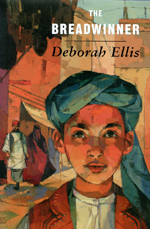
The Breadwinner
by Deborah Ellis
Middle East Book Award 2002

Written in 2000 (and hence pre-9/11), The Breadwinner tells the story of eleven year-old Parvana, a girl growing up in an Afghanistan governed by the Taliban. Before the takeover by the Taliban, her mother was a journalist and her father a teacher. The family lived in a large house, owned a television, and sent their daughters to school. But with the regime change, women were forbidden to work or attend school. The numerous bombings have forced the family from their comfortable home into a one-room apartment in Kabul, and Parvana's father sells his services as a letter-writer or reader in the marketplace.

A few chapters into the book, Parvana's father is arrested. The only reason given is that he was educated in England. With the only male in the family being Parvana's two year-old brother, Ali, Parvana's mother decides that Parvana must disguise herself as a boy in order to support the family until her father's release from prison.

The reason this book seems to be admired is likely because it's one of few books for young readers to detail events in Afghanistan under the Taliban. The writing here is very straightforward, introducing the reader to the culture through the narrative, rather than in lengthy explanations. A short glossary in the back also helps to define some of the foreign words, such as burqa and karachi. While most children reading The Breadwinner are probably unfamiliar with Afghanistan outside of what they might hear on the news, Parvana's presentation as a normal kid will enable them to empathize with her struggle.

Interestingly, Islam is almost entirely absent from the narrative. I'm not sure if the intent here was to prevent the demonization of the religion, though, given when the book was written. Perhaps, instead Ms. Ellis simply didn't want the narrative to become mired in complex explanations of Islamic practices.

Given that Ms. Ellis only spent a few weeks in Afghanistan doing research before writing this novel, some people will complain that it lacks an authentic voice. The issue of authenticity is a complex one, and I will not get into it here. If you are interested in this issue, I highly recommend Malinda Lo's blog post. I will point out, however, that a very similar (albeit more depressing story) is told in the Afghan film Osama, so Ms. Ellis can't be totally off-base.

Grade: B+

Monday, October 3, 2011

The Black Creek Project

Shine
by Lauren Myracle

I devoured this book in one sitting about a week ago for my first book club meeting here in Pittsburgh. At least for the time being, our plan is to read buzz books for the upcoming Newbery and Printz awards, and this was a selection for the latter.

Cat is a sixteen year-old girl in a tiny North Carolina backwater. Her best friend, Patrick, is an effeminate loner who was raised by his grandmother (until her recent death). The book begins with a newspaper article detailing a horrible hate crime committed against Patrick in which he was knocked unconscious by a baseball bat and tied to the gas pump at the station where he worked as a clerk, a gas nozzle stuffed down his throat with a note reading "Suck on this faggot" nearby. He is in a coma, and the local police seem to be doing little to find the culprit. Cat decides to take matters into her own hands and solve the mystery.

Ms. Myracle did a good job in detailing what life in a rural Southern town is like: kids dropping out of school, teen pregnancies, drug abuse problems, bigotry. I particularly liked the ladies who attended church to gossip rather than worship, as well as the portrayal of a closeted athlete and his self-denial. The pacing was brisk, while still managing to tie up the various plot threads by the end, but the writing was just adequate.

My major qualm with this book is that the hate crime committed against Patrick is really just a vehicle to discuss the destructive power of drugs, namely meth. I was expecting an LGBT book, and this doesn't quite fit the bill. This is an anti-drug book. While I don't think the hate crime angle would have worked properly if Patrick hadn't been a gay character, I am rather bothered that he was used in such a degrading manner to tell a compelling story. It reminds me a bit of the "women in refrigerators" from 90's era comics.

Given its subject matter, I can understand why Shine was chosen as a buzz book. I do not feel, however, that it is worthy of winning the Printz medal, as the material could have been handled better by a more capable writer. I'll be the first to admit it's a good read, but this is of the page-turner best-seller variety, not the literary award variety.

Grade: B

Friday, September 23, 2011

New Town, New Possibilities


Okay for Now
by Gary D. Schmidt
National Book Award finalist 2011

The late 60's were a difficult time in which to grow up. Civil rights, the Vietnam War, the assassination of Robert Kennedy...These all made it increasingly difficult to navigate through childhood and adolescence. For Mr. Schmidt's protagonist, Doug Swieteck, add in being the new kid in town, and having an alcoholic father and a brother newly returned from the war. Life is far from easy for Doug.

After a local store is robbed (and the younger of Doug's two older brothers is suspected), Doug is either treated with contempt or ignored completely by his fellow classmates, teachers, and townspeople. The only people who give him a chance are Mr. Powell, the local librarian, and Lil Spicer, the daughter of the local grocer for whom Doug works as a delivery boy. Throughout the book, Doug's moods fluctuate wildly, depending on how he's being treated, which I found to be extremely realistic.

The other major story thread throughout the book concerns a copy of Audobon's bird prints, which are being auctioned off one by one to fund the library. As Doug learns how to draw with Mr. Powell each Saturday, copying the Audobon prints, he gradually becomes attached to the pieces and begins a crusade to return the sold prints to the library. In an age where government funding of libraries is being significantly decreased, as law-makers question the role of libraries in this digital age, it was wonderful to see Mr. Schmidt portray the library as a place of learning, and also for him to promote advocacy.

What I was probably most impressed with was Mr. Schmidt's ability to convey a broad range of emotions through simple text. Since our protagonist begins the book as an illiterate, the sentences are succinct and usually devoid of adjectives, yet they never seem to condescend to the intended audience.

There's a lot of buzz about this book at present, and a good many people are predicting a Newbery. I haven't read the other books that people are predicting will be nominated, so I can't say for certain if Okay for Now will win, but I can say that it's well worth a look.

Grade: A

P.S. I still don't know why the cover depicts a boy with a paper bag over his head.

Wednesday, June 8, 2011

More Than This Provincial Life

First, I'd like to apologize for my long absence. I've spent the last few weeks packing everything I own, moving 450 miles from Chicago home to Pittsburgh, and settling into the new apartment. For much of that time, I've been without Internet, so I'm only just now getting to write about the following book. I am also currently without a library card, having just moved, so posts may be sporadic for the next few weeks.

A Northern Light
by Jennifer Donnelly
Carnegie Medal 2003, Printz Honor Book 2004

In her small turn-of-the-century upstate New York town, Mattie Gokey is considered a bit peculiar. Along with her best friend, Weaver, she continues to attend the town schoolhouse daily, despite being sixteen, in the hopes of receiving her diploma and attending Barnard College. With her mother recently deceased, however, as the oldest child Mattie is expected to tend to her father's farm and her younger sisters. College, and the life it could bring, is a distant dream.

While working a summer job at a neighbouring hotel, the Glenmore, Mattie finds herself embroiled in a murder case, as she is the recipient of a number of letters the victim had written. Despite having been asked to burn the letters by the victim prior to her death, Mattie keeps them, slowly unraveling the motive of the murder.

The book tends to be marketed as a mystery due to the subplot involving the Grace Brown murder, but I would categorize it as an historical slice-of-life novel, as the focus throughout is on Mattie and the various events occuring around her. Those expecting a whodunit mystery will be rather disappointed here.

I felt that Ms. Donnelly did a wonderful job in conveying what ordinary life was like in rural New York in the early 1900's, from detailing mundane farm chores to the attitudes of the day concerning feminism and racial prejudice.  Her meticulous research is not just apparent from the lengthy bibliography in the back of the book, but from the quality and accuracy of the writing itself, which is somewhat rare, even in historical fiction.

More than anything, this book appealed to me because I liked the character of Mattie so much.  I could very easily relate to her, as I was always the odd one with my nose in a book, dreaming of distant locales more interesting than my own, and I thought the "word of the day" chapter headings were a fantastic touch, given Mattie's obsession with vocabulary and writing.  I do have to wonder, though, if the Disney version of Beauty and the Beast had any influence over Ms. Donnelly's writing, as Mattie often reminded me of Belle, just as her love interest, Royal, was a somewhat less chauvinistic Gaston.

Grade: A

Monday, April 18, 2011

Free to Be


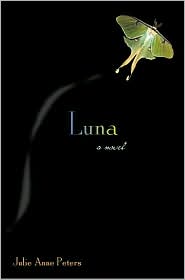
Luna
by Julie Anne Peters
National Book Award finalist 2004, Stonewall Honor Book 2005, Lambda Award finalist 2005

Regan's brother Liam has always been a bit different. His best friends have always been girls and he's always had an interest in fashion. His father suspects that he might be gay, but only Regan knows the truth. Liam is transgendered. Every night she keeps Regan up at odd hours while she dons her dresses, wigs, and make-up, permitting her true self, Luna, to emerge.

This novel is essentially the story of Luna's transition, as seen through Regan's eyes. Unfortunately, with its contemporary setting in the western United States, that story is not a very pleasant one. In addition to a male chauvisnist father and a pill-popping mother who refuse to accept the reality of the situation, Luna has to deal with the taunting of her classmates and local townspeople. With the lack of support and understanding presented to her, Luna contemplates suicide numerous times, and without Regan, who, despite her selfish wish that Luna was not so different, provides the only moral support in this difficult period of Luna's life, she may well have done more than contemplate.

Ms. Peters does a good job of explaining a complex and somewhat controversial topic in terms that a younger audience can understand, though I feel that the book would have been more powerful if told through Luna's point-of-view, rather than Regan's. The decision to use Regan as narrator has ensured that the audience remain outsiders incapable of understanding the problems of a transgendered youth first-hand. While Regan is sympathetic of Luna's plight, she can never truly understand the thought processes that go through Luna's mind, and thus, neither can the readers. True, some readers may be alienated by a book told from the perspective of a transgendered individual, but if so, this book was not written for them in the first place.

I found Regan to be a rather selfish character, more concerned with how her classmates and potential boyfriend would view her as Luna's sister than with how Luna was coping with her situation. Also, I felt that the characterization could have been stronger. Some aspects of the characters, such as their interests and hobbies, seemed like they were just tossed in as an after-thought. For example, Luna apparently is a manga fan, as exemplified by a scene in which her friend Aly returns a copy of Love Hina. But this interest is never explored, which makes me think the author was merely trying to retain the contemporary feel without any knowledge of the pop culture she mentions in passing.

Also, I realize that I am probably ridiculously naive and idealistic, but I seriously had to keep reminding myself that such biased individuals as Jack, the father of Regan and Luna, actually exist. I know that discrimination is still a major issue, especially in the transgender commmunity, but I can't fathom why. People are people. It's very simple. And we should all be free to live our lives however we may choose, provided that no one else is harmed.

I am glad this novel exists so that it might provide some understanding to people who otherwise might fear or mock transgendered people. While there were some minor flaws, I would still gladly recommend this novel.

Grade: A-

Wednesday, March 30, 2011

A Voice from Beyond


Thirteen Reasons Why
by Jay Asher

When honor student Clay Jensen arrives home and finds a package with no return address waiting for him, he opens the parcel and discovers a set of seven tapes, each side labeled with a number from one to thirteen. Finding an old cassette player in the garage, he pops in the first tape and discovers that the tapes were recorded by his classmate, Hannah Baker, who recently committed suicide, and each of the tapes is dedicated to a person whose actions led her to kill herself. The tapes are meant to be mailed to each person on the list until the thirteenth person receives them, and she claims that another set will be released publicly should this not be done.

Hannah is a girl destroyed by rumours. When one boy exaggerates the goings-on during their first date, she earns a reputation of an easy girl, despite having only just received her first kiss from said boy (according to the tapes, at least). From that one rumour, Hannah's life spirals into chaos and depression, leading her to ultimately give up on life, believing that things would never change and people would never see her as she truly was.

As he listens to the tapes, Clay presents the reader with his perspective of the situation, sometimes filling in gaps in Hannah's story. We learn that he had a crush on her, but due to her reputation, he was afraid to pursue a relationship with her. Clay struggles with her death and blames himself for not having seen the warning signs and intervened.

Mr. Asher's idea to tell the deceased's story via cassette tape was rather an innovative one. I don't usually listen to audio books, but I'm quite intrigued by the idea of listening to this particular story.

Chris Crutcher's influence upon the author is certainly apparent, not only in the subject matter, but in the way that the teens in the book grapple with it. However, unlike Crutcher, Mr. Asher doesn't tie everything neatly into a bow by the end, although there are allusions to a possible intervention for another of Clay's classmates.

My only complaint with this debut work was that we are only given one side of the story. While Hannah often acknowledges that the particular actions of a student weren't problematic on their own, but only due to the snowball effect, I would have liked to see the other students on the tapes either defend or clarify their actions.

With its timely subject matter, Thirteen Reasons Why should be required reading for all high school kids.

Grade: B+

Wednesday, March 23, 2011

Disbanding the Boys' Club


The Disreputable History of Frankie Landau-Banks
by E. Lockhart
National Book Award finalist 2008, Printz Honor Book 2008

The titular Frankie Landau-Banks is a devious mastermind behind a semester's worth of pranks carried out by secret societ the Loyal Order of the Basset Hounds. Vaguely familiar with the Order, as her father was a member during his school days, and inspired by the Cacophony Society after doing a project about them for one of her classes, Frankie decides to turn the orderly world of her prep school on its ear, including the boys-only Basset Hounds.

As per usual, this book had been on my "want to read" list for a while, but it was book club that provided the impetus for me to finally do so. While I have read some reviews complaining that the writing could be overly pretentious at times, I found the writing to be one of the novel's greatest strengths. Though at the beginning the novel occasionally fell into the frame of the typical teen romance novel, I appreciated that Ms. Lockhart was confident enough in her readers' intelligence that she devoted an entire chapter to false positives, both real and imagined. I suppose such chapters, as well as the references to the panopticon, are why some view this work to be pretentious.

I didn't find Frankie to be a likeable character, and I could not relate in any way to her desire to break the rules. I also was somewhat disappointed that the novel seemed to assert that those women who choose to engage in feminine activities were doing so only to appear to the men in their lives to be proper women. I certainly shall never deny that a number of women do dress certain ways or, for example, pretend to be less intelligent than they actually are, to attract men. However, to conclude that there is little, if any, personal enjoyment to be found in feminine activities bothered me. In my frilly Victorian-esque dresses, I suppose I appear to most like a lost Disney princess a la Enchanted, but I choose to be this way for no one save myself. I wonder what Frankie would think of such individuals, as she seemed to have such disdain for the other female characters in the book.

While I can understand her desire to be involved in the same activities as the boys, I really felt that she only wanted to be involved in order to assert her superiority over them. She criticized Matthew for keeping secrets from her and for treating her like a pet, but she didn't seem to have much respect for Matthew as a person either. Her interest seemed purely superficial to me, which is probably why I found her so hard to like. I hated her double standards.

Despite my disagreement with the author as stated above and my difficulties with Frankie, I highly recommend this book. Girls should read it for its empowering message (even in the guise of the misguided protagonist), and boys should do so to better understand the obstacles that still impede women from being true equals with men even now.

Grade: A-

Sunday, January 30, 2011

High School Nostalgia


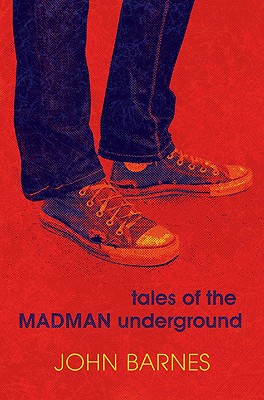
Tales of the Madman Underground: An Historical Romance 1973
by John Barnes
Michael Printz Honor Book 2010

In John Barnes' debut YA novel (he's a Nebula nominated sci-fi author), he brilliantly recreates the first week of Karl Shoemaker's senior year of high school. Karl is an average kid living in an average midwest town (Lightsburg, OH, a fictional suburb of Toledo); however, he's been a member of a school therapy group, dubbed the Madman Underground, ever since his father died. But this year, he plans to avoid the therapy group and live as a normal teenager. Of course, this is much easier said than done.

At over five hundred pages, Tales of the Madman Underground truly dedicates itself to exploring this one week in Karl's life. Of course, in order to understand the impact of various events throughout this week, there are sundry flashbacks explaining why characters are in the Madman Underground. There's Paul, Karl's possibly gay best friend; Cheryl, the sexually abused cheerleader; Squid and Danny, two athletes with alcoholic fathers; and Marti, the new girl who's been to nearly every gifted school in the country and just wants a chance to be normal. Being outcasts, for the most part, the group does its best to help each other out, and given the nature of some of the kids' home-lives, aid is needed relatively frequently.

While the book is set in the early seventies, having grown up in a boring suburb of Pittsburgh in the new millennium, this still read like my high school experience. I knew a number of kids like the characters in this novel; our problems and entertainments were much the same as Barnes describes them. And, while I usually try to prevent myself from coloring my reviews with emotion, I feel that this novel worked so well because nearly everyone can relate to it. While it might have been a tad unrealistic to have so much happen in just one week, I appreciated Barnes' refusal to neatly tie up any loose ends and write a happy ending for our protagonist.

Grade: A-


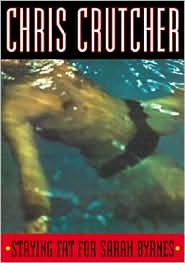
Staying Fat for Sarah Byrnes
by Chris Crutcher


While Tales from the Madman Underground is a semi-realistic portrayal of high school life, Staying Fat for Sarah Bynes reads more like an after-school special. The basic premise is that overweight swimmer Eric's best friend, the titular Sarah Byrnes, enters a catatonic state and is admitted to a mental ward. The two had bonded as kids due to their status as outcasts, as Sarah was horribly burned on her face and arms as a child and never received reconstructive surgery. Over the course of the novel, Eric discovers that Sarah's father has been abusing her and is forced to choose between telling an adult and losing Sarah's trust, or staying silent and possibly losing her completely.

While I enjoyed the oft snarky narrative of Eric, and the book did an excellent job of discussing sensitive issues like abortion with all sides accounted for, I feel the end of the book is completely unbelievable. A side character, who is barely present throughout the book, manages to intercept Mr. Byrnes, and the swim coach, who, while she has affection for Eric, barely knows Sarah, takes her in immediately. Had the ending not been so trite, I feel this novel would have been considerably stronger, but as it is, all of the work Crutcher puts into his characters is diminished by this happy ending.

I suppose it's a product of its time. I remember reading a number of novels in the 90s that had their respective protagonist surmounting unlikely obstacles. With a subject such as abuse, one can understand wanting the happy ending, especially when all too often, such endings never happen in reality, but if it had been curbed even slightly, it might have been more realistic. Despite its flawed ending, I still recommend this novel.

Grade: B+

Thursday, November 18, 2010

Losing My Religion


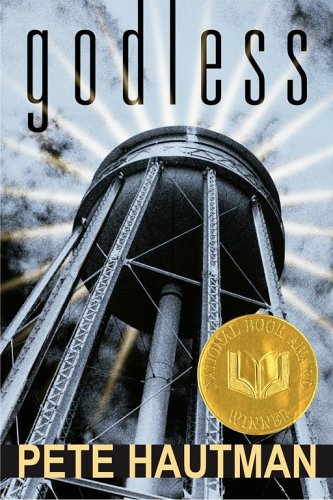
Godless
by Pete Hautman
National Book Award for Young People's Literature 2004
Religion is a very difficult issue to discuss. Questioning religion, which is the main premise of Hautman's Godless, is even more difficult to present well, especially to a young audience. Through the agnostic-leaning-toward-atheist protagonist Jason, the author asks all the right questions pertaining to faith and religion, though none are answered by the novel's end. This is, perhaps, a wise decision, as it permits the audience to decide for themselves whether or not to believe in any given religion, thus enabling the author to present occasionally negative views on organized religion without leading the reader to accept them.


After Jason concocts the idea to create a religion centering around the town's water tower, he recruits his friends to join his newly founded faith. For the most part, the kids regard the whole enterprise as a goofy activity that keeps them from complete boredom. However, Jason's best friend, Shin, becomes totally engaged with the concept, even going so far as to write a holy book to accompany their new religion (the excerpts from which become the headers of each chapter, typically paralleling the events described therein). As a foil to Shin's religious fanaticism, we have the town bully Henry, who uses "Chutengodianism" as an excuse to vandalize public property and dictate the actions of his friends. I must say I was happy to see so many variations of religious experience within the novel, and the portrayal of Just Al, the leader of the Catholic youth group Jason is forced to attend, was spot-on in his blind faith.

I have to admit, though, I'm a bit puzzled as to why this particular work won the National Book Award. It was certainly engaging, and it posed all of the right questions, but it just didn't have much impact. Maybe Octavian Nothing spoiled me, but I was just expecting more from a novel that won such a prestigious award.

Grade: A-