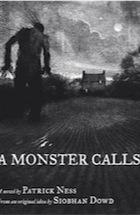
A Monster Calls
by Patrick Ness
Thirteen year-old Conor's mother is dying from cancer, though neither he nor his mum will admit this. His grades in school are slipping, but the teachers give him a pass, ignoring him for the most part, as do the other students, with the exception of a few bullies. His father is in America with a new wife and baby, and his uppity grandmother is coming to stay with them. Conor wonders how his life could possibly get any worse.
Haunted by nightmares each night, Conor isn't terribly surprised when a yew tree in his yard springs to life and threatens to devour him if Conor doesn't tell him his own story after the yew tree finishes telling three of his own. Suspecting it's a dream at first, Conor awakes the next morning to find piles of leaves and berries scattered on the floor of his bedroom.
Mr. Ness is a fabulous writer, and here he shows that he is just as capable of writing a compelling story for middle grade readers as he is for teens. Each of the monster's stories parallels an event in Conor's life, though the outcome of each tale is often far different from what he (and readers) might expect. More sophisticated readers will pick up on the extended metaphor represented by the monster sooner than the final reveal, yet that doesn't weaken the story, as Mr. Ness crafts a very emotional climax.
Accompanying the story, which was written from an idea by the late Siobhan Dowd, are brilliant illustrations by Jim Kay, who manages to capture the emotions of the book perfectly.
I honestly cannot recommend this book enough. I have difficulty empathizing with real people, let alone fictional ones, but the writing here is just so good that even I had my heart wrenched by the end. I will be shocked if this isn't at least short-listed for the Newbery this year.
Grade: A+
Showing posts with label Patrick Ness. Show all posts
Sunday, October 9, 2011
Friday, June 24, 2011
Congratulations to Mr. Patrick Ness!
Earlier today, Mr. Ness announced on his blog that he has won this year's Carnegie Medal for Monsters of Men, the third in the Chaos Walking trilogy. You can read my review of the series here.
In Mr. Ness's acceptance speech, he heavily criticized the closure of libraries happening all over Britain. It's terrible to think that library closures are not only an American problem, but it's also wonderful to have such powerful advocates. Please don't only read Mr. Ness's brilliant books, but go out and support your library, wherever you are!
Sunday, January 9, 2011
Land of Confusion

The Chaos Walking Trilogy
by Patrick Ness
Consisting of: The Knife of Never Letting Go, The Ask and the Answer, and Monsters of Men
Guardian Award 2008, Carnegie Medal short-list 2009 (The Knife of Never Letting Go); Carnegie Medal short-list 2010 (The Ask and the Answer)
I first began the trilogy in November when my book club read The Knife of Never Letting Go. At first, I didn't particularly like it, as the protagonist Todd and the stream of consciousness style were both a bit annoying, but once the momentum started to build, it was difficult to put down.
The main premise concerns a planet, known only as New World, that has been colonized (presumably by Earthlings, though one cannot be certain, as they refer only to their ancestral home as Old World). On New World, there is a curious ailment, called Noise, that affects all men, broadcasting their every thought to those around them. Animals are also affected by this, but women are somehow immune. At the beginning of the first novel, we are told that all of the women of Prentisstown have died from a virus released by the native Spackle during a war decades earlier.
When Todd discovers a spot in a nearby swamp in which there is no Noise, he reports it to his adoptive parents, Ben and Cillian, who immediately pack up his belongings and urge him to flee, fearing for his safety. The quiet is, in actuality, a girl named Viola, recently marooned in the swamp when her scouting ship crashed. Having no way to contact the coming colonists she left behind, her only choice is to trust Todd and hope that the fabled settlement of Haven has the means with which she might contact the others. Thus begins an unrelenting race to reach Haven before Prentisstown and its power-mad mayor has the opportunity.
Along their journey, Todd and Viola encounter various other settlements, each with a different social hierarchy than Prentisstown, including a matriarchal society and another town where men and women live apart from each other. In the later installments of the trilogy, Ness delves deeper into gender issues, pitting Mayor Prentiss' group of men against a terrorist organization led by and comprised mostly of women. The stakes are amped up higher by Ness' choice to put Todd and Viola on opposing sides, connecting each of them to the leaders of each side (Mayor Prentiss and Mistress Coyle, respectively).
Ness also creates an intriguing race in the native Spackle, who share a collective consciousness with each other and the world itself. Their language is expressed through thought-broadcasting (the Noise so despised by the colonists), and late in the series it is questioned if the human race is capable of ever fully utilizing this thought network as the Spackle do.
While the first novel is narrated solely by Todd, subsequent installments add one narrator each, so the third volume has three distinct voices (Todd, Viola, and a Spackle known as 1017). Interestingly, the series uses different fonts for each character, so one knows at a glance whose thoughts are recorded on the page; however, several members of the book club that I attend have noted that the e-book does not maintain these different fonts.
I don't think I've read such a highly lauded series that so challenges readers' thinking since first reading His Dark Materials by Philip Pullman. I cannot recommend this series enough, and although it is often dark and grim, the conclusion is a satisfying one in which we hope the characters might find the bright future of which they dream.
Series Grade: A+
Labels:
Carnegie Medal,
dystopian,
Patrick Ness,
science fiction,
YA
Subscribe to:
Posts (Atom)
