Showing posts with label Dream Factory. Show all posts

Saturday, May 16, 2015

Dream Factory: Galavant

Galavant
Original airdate: January 2015
Original US broadcaster: ABC
Episode total: 8
Availability: Streaming on Hulu
Grade: C+


Summary from Rotten Tomatoes: "A medieval hero fights to win back the love of his life, Madalena, from the evil king who stole her in this musical comedy."

At a length of only eight episodes, Galavant manages to cover a significant amount of plot with numerous twists along the way.  Within the first two or three episodes, the synopsis from Rotten Tomatoes and IMDB has been discarded, as Galavant shifts his focus to helping Isabella, the princess of Valencia, rescue her parents from King Richard, who has overthrown the kingdom along with his new bride, Madalena.  Add numerous side plots, ranging from land pirates to an adorable relationship between Richard's cook and Madalena's handmaid, and there's almost too much stuffed into each 22 minute episode.

Despite the pedigree of the show's composer, Alan Menken, the majority of the tunes are woefully forgettable with a few exceptions (the title song, which is reprised so many times it's impossible to forget,  and a riff on Sweeney Todd's human pies sung by the cook and maidservant).  I don't believe it's Mr. Menken's fault, however.  It's the format that's damaging.  Stuffing 3 or 4 songs into 22 minutes seldom works for children's shows, let alone adult fare, and here many of the songs fall flat.  While the writing on Smash may not have been the best, nearly every song on the show had a purpose, which is something that cannot be said of the songs on Galavant.  Perhaps in its second season it will expand into an hour-long format and combat this problem.

My other qualm with the show was its plethora of potshots and cheap jokes.  Given its renewal and vocal fanbase, I'm apparently in the minority, but I was expecting witty dialogue, puns, and wordplay for some reason, not sex jokes and stereotypes (see the episode where the group visits the squire's Jewish village for reference).

Regardless of the issues I had with the show, I am glad to see something on US TV that's at least trying to break the mold, even if it's not entirely successful.  Here's hoping season two is better. 


Monday, January 19, 2015

Dream Factory: Into the Woods

Into the Woods
Director: Rob Marshall
Original release date: Disney 2014
Golden Globe Award for Best Motion Picture - Musical or Comedy 2015 nominee
Rating: PG
Grade: B


Summary from Rotten Tomatoes: Into the Woods is a modern twist on several of the beloved Brothers Grimm fairy tales, intertwining the plots of a few choice stories and exploring the consequences of the characters' wishes and quests. This humorous and heartfelt musical follows the classic tales of Cinderella, Little Red Riding Hood, Jack and the Beanstalk, and Rapunzel -all tied together by an original story involving a baker and his wife, their wish to begin a family and their interaction with the witch who has put a curse on them.

As an aficionado of both fairy tales and musicals, I had been anticipating the release of the film version of Into the Woods for some time, especially since it's an adaptation of a Stephen Sondheim musical.  Of course, I knew that there would be changes since Disney was marketing it as a family film, but there were still more than I expected.

A number of songs have been truncated or excised completely to shorten the length of the show, which I feel is to its detriment.  Some of the songs that were removed included "Ever After" and "No More,"  which both appear only as instrumentals.  The reprise of "Agony" has also been removed and with it the subplot of the Princes' respective affairs with Snow White and Sleeping Beauty.  I suppose it was to be expected that the "adult" subject matter would be removed or significantly toned down given Disney's involvement, but it muddled the plot in regard to Cinderella's decision to leave her prince.  It should be noted that the violence has been altered, as well.

I appreciated that this version of Cinderella's story used her dead mother's spirit instead of the fairy godmother that has become so iconic. I had worried that it would be changed for the film.  It's worth noting that Rapunzel's prince is still blinded, but Rapunzel neither bears a child nor dies in this version.  

As for production values, the costumes and sets are all fairly detailed and the effects, such as the bean stalks and the Witch's transformation, are pretty impressive.  There's also a good mix of celebrities and stage performers who all do a good job performing the songs.  I don't think Meryl Streep deserves awards nominations for her role here, but considering the shoes she had to fill, I still enjoyed her performance.  

All in all, Into the Woods is a good film that may serve as a great introduction to Sondheim.  It can't replace a live performance, however.

Saturday, July 26, 2014

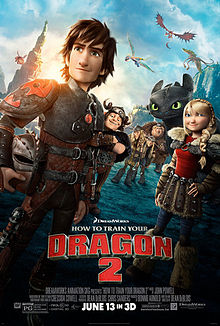
Dream Factory: How to Train Your Dragon 2

How to Train Your Dragon 2
Director: Dean DeBlois
Original release date: DreamWorks Pictures 2014
Rating: PG
A

Summary from IMDB: When Hiccup and Toothless discover an ice cave that is home to hundreds of new wild dragons and the mysterious Dragon Rider, the two friends find themselves at the center of a battle to protect the peace.


Five years have past since the events that transpired in the first film.  As the story begins, Stoick is grooming Hiccup to replace him as chief of the village, but Hiccup focuses instead on traveling with Toothless to create an expanded map of the area.  He has also been tinkering with a set of wings for himself, although each practice attempt has resulted in a crash landing thus far. 

On one of their journeys, the duo encounters dragon poachers, but are rescued by a mysterious masked dragon rider.  Once Hiccup learns more about the poachers, he must rally his friends before the poachers capture all of Berk's dragons.

Those who are fans of the first film shouldn't be disappointed with this installment.  While the film has a number of serious moments, the trademark humor is still present in the side characters, such as Ruffnut and Fishlegs.  And the animation quality has only been improved since 2010.

What I most appreciated was the attention dedicated to a major secondary character's death.  Many family-oriented films will skim over such death sequences, but the writers here respect their audience and the scene they've created.  The scene in question is one of the most emotional in either of the films, not only because of the death, but because of how the death affects the relationship between Hiccup and Toothless.  Even though attentive viewers will see the foreshadowing of the death in earlier scenes in the film, it still stirs the emotions, which is a sign of how strong the writing is here.

My only real complaint with the film is that Hiccup is the only character who is given time to develop over the course of the film.  Astrid and his friends are very much side characters here, and the relationship between Hiccup and Astrid seems tacked on.  I haven't watched the TV show, so maybe it was developed more there?  If not, I hope the next film allots some time for other characters to mature and change.

I'm not sure why this film hasn't been doing better at the box office, as it's a solid, well-animated installment.  Fans of the franchise and of animation in general should definitely see it at the cinema.

Monday, July 7, 2014

Dream Factory: Maleficent

Maleficent
Director: Robert Stromberg
Original release date: Walt Disney Pictures 2014 
Rating: PG
B

Summary from Rotten Tomatoes: Maleficent explores the untold story of Disney's most iconic villain from the classic Sleeping Beauty and the elements of her betrayal that ultimately turn her pure heart to stone. Driven by revenge and a fierce desire to protect the moors over which she presides, Maleficent cruelly places an irrevocable curse upon the human king's newborn infant Aurora. As the child grows, Aurora is caught in the middle of the seething conflict between the forest kingdom she has grown to love and the human kingdom that holds her legacy. Maleficent realizes that Aurora may hold the key to peace in the land and is forced to take drastic actions that will change both worlds forever.


As both a fan of fairy tales and Disney villains, I was excited when Maleficent was first announced a few years ago, albeit apprehensive given the last few live-action films released by Disney.  And while the critics have given mostly mixed reviews to Maleficent, I thought there were some great elements in it that just needed to be elaborated upon.

One of my major concerns, other than the story itself, was the special effects.  In recent years, there has been an increasingly apparent shift away from practical effects towards CG ones.  Sometimes those CG effects blend seamlessly with the live-action shots, while more frequently they are obvious and seem hollow.  The effects here are somewhere in the middle ground.  They're not perfect, but they're also not shoddy.  Being a practical effects enthusiast, I would have preferred to see the faerie realm as depicted by Jim Henson's Creature Shop, but considering that the majority of creatures were CG, they still managed to convey themselves as creatures with souls.

Fans of Eleanor Audley's portrayal may be a bit disappointed, as Angelina Jolie creates her own interpretation of the character for the most part.  The only Audley-esque scene is the christening of Aurora, which replicates much of the dialogue from the 1959 film.  Those expecting a rehash of the animated film from Maleficent's perspective will be surprised, as much of the latter half of the film is completely different, rather than just presented from a different viewpoint.

Some things worked well, while others did not, though at the risk of spoiling things for those who haven't seen the film, I won't elaborate.  Maleficent's motivation for revenge was justified, but in her rage, she harmed those who were innocent of the betrayal.  I thought this was portrayed very realistically and greatly enjoyed Maleficent's quest for redemption through her role as "fairy godmother."  Both she and Aurora were much more complex characters here than in the 1959 film, while the three "good fairies" were relegated to the role of comic relief.

While I applaud the attempt at not only introducing feminist themes to the work, but also the parallelism of the sleeping victims (Maleficent and Aurora), I found some of the narrative problematic.  Namely, the lack of positive male characters.  It's important that when empowering female characters, we don't villainize the male ones, but that's what happened here.  I'm not trying to excuse the actions of Stefan, as they were abhorrent.  I'm just pointing out that the film would have been more balanced if there were a good male to balance out Stefan's evil.  I think they attempted that with Philip (attempted being the operative word), but he's barely in the film so he doesn't do much to counteract Stefan.  I should note that I'm also not calling for Philip (or another male) to be the hero.  Aurora and Maleficent do a fine job of thwarting the king themselves.  I just want balance in the portrayals of characters of both sexes.

All in all, an enjoyable attempt to retell a classic fairy tale from a different perspective, even if it has its flaws.


Monday, June 9, 2014

Dream Factory: Once Upon a Time in Wonderland

Once Upon a Time in Wonderland
Original airdate: October 2013 - April 2014
Original US broadcaster: ABC
Episode total: 13
TV PG
Availability: No DVD release date announced, episodes available for download purchase through Amazon
D+

Summary from Rotten Tomatoes: "In the first and only season of this spin-off from Once Upon a Time, a young Victorian Englishwoman named Alice (Sophie Lowe) is taken to an asylum after sharing fanciful tales of a magical world on the other side of a rabbit hole. Just before she's about to have an operation to make her forget about these tales, the Knave of Hearts (Michael Socha) saves her and transports her back to Wonderland. Upon returning, she tries to reunite with Cyrus (Peter Gadiot), the genie with whom she fell in love. But the reunion is not easy, because Wonderland is populated with its share of villains, including Jafar (Naveen Andrews) and the Red Queen (Emma Rigby)."

The summary alone should indicate that this show was a bit of a trainwreck and suffered from many of the same issues as Tim Burton's 2010 Alice film: the writers seemed to have no knowledge (or respect) for the original work.  Wonderland became a generic fantasy world where its bizarre flora and fauna were frequently treated as threats to our maudlin protagonists.  Merging the Wonderland characters with Agrabah and Jafar only confused the writing more.  It's still unclear to me why the writers chose to combine these stories to create one convoluted plotline.  If they had focused instead on making a Wonderland heavily rooted in the work of Lewis Carroll, perhaps it would have fared better.

The CG for this show, which is used in the sets and any non-human characters, was some of the worst CG on television.  Instead of creating a unique world that the audience would want to visit, its quality was so hokey that it was laughable.  It was the CG equivalent of visible wires.  If a show doesn't have the budget to use good CG effects, then I'd much rather have constructed sets and puppets.  Well-made sets and props will age much better than low-budget CG.

Unfortunately for the show, the CG quality was the least of its problems.  In addition to distractingly bad hairstyling (at least in the first few episodes), the writing was lackluster.  The romance between Alice and Cyrus was disgustingly saccharine for no apparent reason.  They made Snow and Charming seem like a normal couple, which is saying a lot.  I understand that the producers likely thought that a romance would induce viewers to keep watching, but I found it to be superfluous and completely unrelated to the original work.  It was obviously shoehorned in, as was the relationship between the Knave and the Red Queen. 

That being said, the Knave was one of the only likeable characters on the show, with the other being Jafar.  I'm not sure why the Once writers have such difficulty writing believable good characters, but it's only the villains and neutral characters that seem to have any depth.

To be honest, I kept watching each week with the hope that things would improve, but instead I found myself MST3king each episode.  It was the worst show I watched this year, and I'm glad that it was canceled so I don't have to find time for it each week next season.  

Tuesday, November 5, 2013

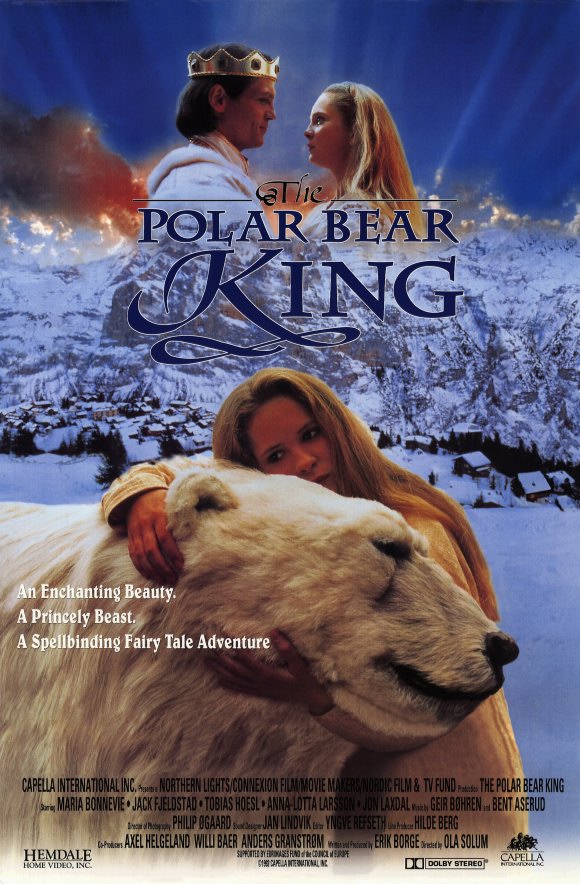
Dream Factory: The Polar Bear King

The Polar Bear King
Director: Ola Solum
Original release date: Capella International/Nordisk Film & TV Fond 1991 (Norway/Germany)
US release date: Hemdale Films 1994
US DVD release date: Mill Creek 2011
Streaming: Hulu
Rating: Not rated
Grade: C+

From IMDB: "After his father is killed, King Valemon ascends the throne, only to be turned into a polar bear by a bitter witch who wants to be his queen. Valemon must find a bride in the seven year span that he'll be a polar bear, and so he travels to Winterland and finds a wife to take home. Although they are happy, she is not allowed to look upon his face when he turns back into a man at night. When she breaks this rule, Valemon will be trapped to the witch forever."

The Polar Bear King is a very straightforward, faithful adaptation of the fairy tale "Valemon the Bear King," which has striking similarities to "East of the Sun, West of the Moon."  As a family film, I did not expect the text to be subverted in any way, but I was a little disappointed that there was no new spin on the story.  The characters were all extremely archetypal, as in the original tale, and I feel I would have better enjoyed the film had the characters been fleshed out and developed into individuals particular to the film, rather than stock characters who could be inserted into nearly any fairy tale.  But for those simply looking for a film version of "Valemon," it's well-made and enjoyable.

The version streaming on Hulu is the English dubbed version, so I cannot speak of the original Norwegian audio, but I found the dub rather distracting.  It's far from being a terrible 1960's dub such as was given to Speed Racer or Godzilla, but it is obvious (to adults, at least) that it's a dub.  The voices don't quite fit the characters, and the acting is often rather wooden and detached.

As for more technical aspects, the special effects are beginning to show their age.  I read somewhere that Jim Henson's Creature Shop was involved with the animatronics.  For comparison, the effects used in The Storyteller seem to have aged better, but it's been a few years since I watched that series. The costumes and sets are both decently constructed, though not nearly as elaborate as what one would expect from a Hollywood film.  It all reminded me very much of the production values of the BBC adaptation of the Narnia books.

The Polar Bear King is well-suited to families looking for all-ages fantasy fare, but not for those looking for an innovative spin on an old classic.


Thursday, October 10, 2013

Dream Factory: Bluebeard

Bluebeard
Director: Catherine Breillat
Original release date: Arte 2009 (France)
US theatrical release: Strand Releasing 2010
US DVD release date: Strand Releasing 2010
Streaming: Netflix
Not Rated
C+


Summary from Seen That: "An adaptation of the classic tale of a wealthy aristocrat with a blue beard."

Review: The narrative of Perrault's fairy tale is set in 17th century France here, where two sisters, Anne and Marie-Catherine, have recently lost their father.  The tale continues in much the same way as the original, with the younger sister marrying Bluebeard and discovering his secret chamber of horrors.

The narrative is framed by two sisters in the 1950's, Marie-Anne and Catherine, reading the story aloud in an attic chamber.  The younger is rather sassy, and, despite the pleas of her elder sister to stop reading the tale, she continues to read, the end result of which is tragic.

The entire film is rather understated, the performances of the leads muted.  To be perfectly honest, nothing in particular jumps out or demands a second viewing in order to parse together some meaning.  The telling of this timeless tale is very straightforward; no non-linear storytelling or juxtaposition of narratives to clearly delineate perceived parallels.  Nearly every scene with the 1950's sisters clearly depicts them reading the tale, save one.  In said scene, Catherine has reached the point in the story where Marie-Catherine enters the forbidden room to find bloody corpses hanging from the ceiling.  But, rather than the scene portraying Marie-Catherine in the room, it is Catherine that we see.  And it is this scene alone that emphasizes the parallels between Marie-Catherine and Catherine, so that when both lead those they love to tragedy, we recognize their similarities.

For those interested in fairy tale adaptations, it's a serviceable film; however, I would not go out of my way to watch it.


Tuesday, August 6, 2013

Dream Factory: Fire and Ice

Fire and Ice
Director: Ralph Bakshi
Original release date: 20th Century Fox 1983
DVD release: Blue Underground Entertainment 2005
Streaming: Netflix
Rated PG
C-


Summary from Seen That: "In this animated tale, a tiny village is destroyed by a surging glacier, which serves as the deadly domain for the evil Ice Lord, Nekron. The only survivor is a young warrior, Larn, who vows to avenge this act of destruction. The evil continues, however, as Nekron's palace of ice heads straight towards Fire Keep, the great fortress ruled by the good King Jarol. When Jarol's beautiful daughter, Teegra, is abducted by Nekron's sub-human ape-like creatures, Larn begins a daring search for her. What results is a tense battle between good and evil, surrounded by the mystical elements of the ancient past."

The 80's were full of forgettable fantasy fare, and were it not for the ability to MST3K, Fire and Ice would probably be on that list.  It begins with an info dump attempting to convince the audience that the film will be far more epic than it actually is, then segues to a fight with Nekron, who seems to be having ice-gasms while fighting the tribe of warriors of which Larn is a member.  For me, it was the unintentional homoeroticism that made Fire and Ice enjoyable, so if you aren't amused by that sort of thing, you probably just want to avoid this film.

The rotoscoping is pretty decent, especially compared to Mr. Bakshi's Lord of the Rings, though there are some scenes where the footage seems to be deliberately slowed.  The costume "designs" are terribly lacking, with nearly every character parading around in loin cloths and string bikinis, even though the majority of the film takes place in the glacier where Nekron dwells.  I suppose we're meant to suspend our disbelief when no one dies from hypothermia.

The hero, Larn, is pretty lame.  Darkwolf (the dude with the ax in the above photo) is the one who actually fights and defeats Nekron.  Larn seems to only be included so that the audience has a young novice character to identify with, but Larn does nothing in this film but get into trouble.  Don't even get me started on Teegra.

In addition to the obvious wish fulfilment elements, the film is problematic in its name and design of Nekron's henchmen.  Rather than orcs or goblins, Nekron has "sub-humans," which have similar builds and facial structures to Alaskan Natives. I understand that this is a fantasy world, but I think the creators should have put much more thought into their portrayal of this particular group.  The best way would have been to create a fantasy race, but since they didn't, they could have at least given them a more suitable name and made them more intelligent.  The "sub-humans" here are basically depicted as Neanderthals who repeatedly try to kidnap and rape Teegra.  Yeah...it's pretty offensive.

All in all, unless you are looking for an unintentionally bad film to mock with your friends or are really interested in rotoscoping, I'd avoid Fire and Ice.


Thursday, July 18, 2013

Dream Factory: Valerie and Her Week of Wonders

Valerie and Her Week of Wonders
Directed by Jaromil Jires
Original release date: Barrandov Studios 1970 (Czechoslovakia)
US theatrical release: Janus Films 1974
US DVD release: Facets 2004
Streaming: Hulu
Not-rated
B+


Summary from Seen That: "Inspired by fairy-tales such as Alice in Wonderland and Little Red Riding Hood, Valerie and Her Week of Wonders is a surreal tale in which love, fear, sex, and religion merge into one fantastic world." 

Review: Since the above summary is especially vague, I'll do my best to do a short one myself.  

Valerie lives alone with her grandmother.  A troupe of actors has just arrived in her village, as has a missionary returning from Africa.  A hooded figure among the performers takes an interest in Valerie, though she learns he is a vampire.  A bespectacled youth named Eagle serves as her protector (along with a magic pair of earrings), as Valerie navigates the tricky path between childhood and adolescence, innocence and sexual awakening.

This film was recently available for free viewing on Hulu as part of their 101 Days of Criterion festival.  It sounded quirky, and I remember having read about it somewhere, so I decided to watch it.  And it delivered all the weirdness one could want.  

The film has a very surreal, dreamlike quality to it.  One is never quite sure what is real and what is imagined, and the characters frequently change their stories.  By the end of the film, the viewer (and Valerie) has been told at least three different iterations of Eagle's origin.  I did think the music used to alert viewers to certain repeating events became a bit gimmicky toward the end, but that was my only real complaint.

The actors here aren't professionals, as this film is part of the Czech New Wave of the late 60's/early 70's.  The leads weren't particularly emotive, but I may have just felt that way because tone doesn't always translate.  The missionary also had a really comic bedroom scene that amused me, though I don't know that it was intentional.

But what really stood out was the imagery.  This film is riddled with sexual imagery, from the obvious (a woman self-stimulating on a tree) to the more subtle (Valerie's entirely white bedroom).  I'm sure someone has to have analyzed every image by now, so I won't, but I think that's where this film really excelled.

I recently learned that this was based on a Czech novel by Vitezslav Nezval, which was only translated into English within the last decade.  I think I will have to read it for a comparison.

I feel like fans of Svankmajer would enjoy this the most.  But anyone with a penchant for the bizarre or the surreal should find something to enjoy.

Note: I scoured YouTube for a trailer, but I could only find fan-made ones.  Sorry.


Saturday, March 9, 2013

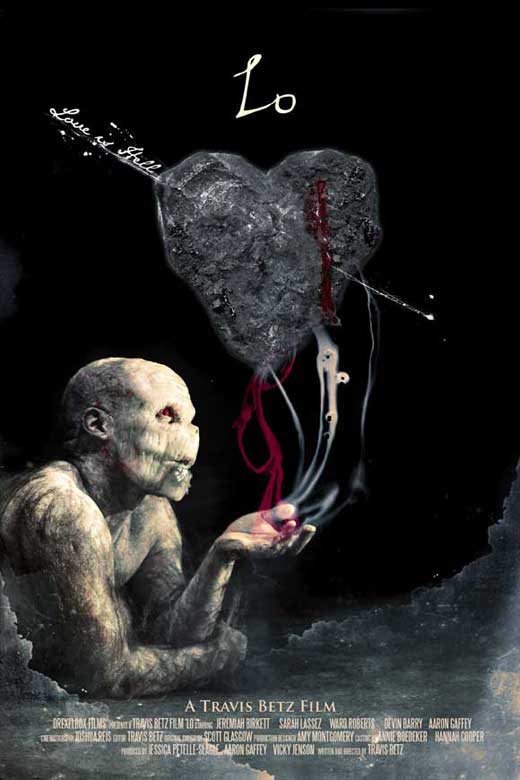
Dream Factory: Lo

Lo
Directed by Travis Betz
Theatrical release: Drexel Box Productions 2009
DVD release: Entertainment One 2010
NR; mature content
C


Justin's girlfriend April has been taken by demons.  Desperate to save her, he summons the demon Lo with a mysterious book she left behind.  But the crippled Lo is not all he seems, as Justin reflects on his time with April and the sacrifice he's willing to make.

This is a low-budget independent film and obviously so.  However, that does not mean it's equivalent to The Room or the works of Ed Wood.  While it has its problems, Lo is a solidly made indie that is meant to be enjoyed, not laughed at (although some of the dialogue is intentionally funny - feel free to laugh at that).  

Some of (okay, probably most of) the acting is pretty wooden.  Aside from Jeremiah Birkett, who portrays Lo, the cast seems like a small-town community theatre troupe.  The acting is never so bad as to distract viewers from the story being told, but it is definitely noticeable.  It's also the primary reason I awarded the rating I did.

That being said, the effects make-up for the demons is pretty good.  I personally love old school effects, and I expect most of the budget was used on them here.

What really made this particular film enjoyable for me, though, was the story.  While Justin's character wasn't explored in-depth, his relationship with April was.  As Justin described events like their first meeting and first Christmas together, a new version would be acted out as a scene by the actors portraying Justin and April, revealing new information to Justin that altered his perception of events.  Given the limited budget and set constraints, I thought it was an interesting way to convey the story.

In addition to the theatre segments, there are other quirky devices like a soft rock ballad interlude performed by a demonic band (Jeez and the Go-to-Hells) and internal monologue.  While I anticipated the twist ending before the big reveal, I thought it was well-done and not completely predictable.

If you like off-beat love stories and don't mind low budget stuff, please give Lo a chance.

Here's the trailer:


Thursday, February 21, 2013

Dream Factory: Les Visiteurs du Soir

Les Visiteurs du Soir
a.k.a. The Devil's Envoys
Directed by Marcel Carne
Original release: DisCina 1942 (France)
US theatrical release: Superfilm Distribution Corporation 1947
US DVD release: Criterion Collection 2012
Streaming: Hulu
Not rated
B+

Gilles and Dominique, a pair of minstrels, arrive at the estate of Baron Hugues during the celebration of his daughter Anne's engagement to Renard and perform for the entourage.  Having sold themselves to the devil, they are here to ensnare the betrothed.  Through magic and trickery (including a spell that freezes time), the envoys attempt to seduce Renard and Anne.  While Dominique successfully toys with both Renard and Baron Hugues, unlucky Gilles falls in love with Anne, who returns his feelings.  As the devil's plans unravel, he arrives himself to set things "right."

Les Visiteurs du Soir isn't particularly famous, overshadowed by Mr. Carne's later film Children of Paradise, but that doesn't mean it's a forgettable film.  It's remembered as an allegory of the French resistance during the German occupation of WWII, although this was not the director's intent.

Mr. Carne operated under the banner of poetic realism, which favored stylized sets over realistic location shooting, and often featured ill-fated characters who lived on the margins of society.  Gilles easily fits the mold here, being a poor lover who mistakenly entered into a Faustian bargain.  His former lover, Dominique, no longer cares for him, enjoying the conquests ordered of her, and he feels trapped by the confines of his extended life and the restrictions of his contract.  Upon realizing that he is in love with Anne, he attempts to spurn her, rather than sacrifice her to the devil, but their love proves to be too strong.  In the end, he has her love, but not his life.  It's quite fatalistically romantic!

The special effects used are fairly basic, but they've aged decently.  Or, at least, they aren't reminiscent of cheesy Dark Shadows effects.  The costumes and sets also appear to have been made on a fairly large budget.

Not being a French speaker, I can't really comment much on the acting, although I did enjoy the performances of Alain Cuny (Gilles) and Jules Berry (the Devil).

This film actually reminded me of a distilled The Seventh Seal, likely because of the fatalism, time period, and supernatural goings-on.  While it would be unfair to compare this to Mr. Bergman's masterpiece, it's fairly enjoyable, if slow at times, and I feel that fans of cinematic fantasy will enjoy it.

Here's the original French trailer:

Monday, November 5, 2012

The Dream Factory: Frankenweenie

Frankenweenie directed by Tim Burton
Walt Disney Pictures 2012
Rated PG
Academy Award for Best Animated Feature Nominee 2013
BAFTA Award for Best Animated Film Nominee 2013
Golden Globe Award for Best Animated Feature Film Nominee 2013
Annie Award for Best Animated Feature Nominee 2013
A-

I can clearly remember being seven and first seeing advertisements for The Nightmare Before Christmas in my Disney Adventures magazine.  Mr. Burton's ghoulish ink illustrations, used as promotional art, captured my imagination and I began to entreat my parents to take me to the film, though no one else in the family was particularly interested in going to see it.  The film, my first experience with stop motion animation, ignited a lifelong love for the art form, as well as for the story's writer, Mr. Burton.


Since 1993, Mr. Burton has both inspired me and disappointed me, but as I sat in the cinema waiting for his latest creation to begin, I had high hopes that Frankenweenie would belong to the former group and I was not disappointed.

The film follows the same storyline as that of the 1984 short (which I have fond childhood memories of watching every Halloween on the Disney Channel).  When Victor Frankenstein's dog is hit by a car, he attempts to resurrect him with electricity on a stormy night and succeeds.  The film, needing to flesh out the plot, introduces a science fair at Victor's school, and discovering Victor's project, the other students (all of them parodies of some horror figure or other), resurrect their own pets.  But, their motivations being quite different than Victor's, the pets rampage through the town and Victor must devise a way to stop them.


I wasn't expecting this film to be a comedy, but I found myself laughing aloud quite frequently at the numerous horror references sprinkled throughout the film.  Most of these jokes went over the heads of the children in attendance, and I think my husband and I were the only ones laughing most of the time due to the demographics of our particular screening.  But the relationship between Victor and Sparky, his dog, are something all people with pets can relate to, so the references shouldn't prevent non-horror fans from enjoying the film.

Aside from what felt, to me, like a mixed message about science and the failure to teach younger viewers a valuable lesson about letting go, the film hit all the right notes.  This is Mr. Burton as himself, filled with whimsical nostalgia and none of the soulless commercialism of his last few films.