Showing posts with label Rick Yancey. Show all posts

Sunday, May 15, 2011

Saving the Monstrumologist


From Rick Yancey's Facebook: "I have just received word that the publisher of the series will NOT be renewing the contract for any future books after the release of Isle of Blood in September. Though the good folks at Simon & Schuster are quite proud, as I am, of the books’ critical success, sales simply have not been what either of us had hoped for. In short, the series is dead unless by some miracle sales of the books take off. I wanted to take this opportunity to publically thank S&S for believing in this project, my family for supporting me through the long nights and weekends while I struggled to “edit” Will Henry’s journals, and, of course, you, the fans of the series who have cheered for its success. I am very proud of you and very thankful that you came to share my passion for these characters and their world. I encourage you to share your passion with your friends and feel free to drop me a line here or at my website. If you are so inclined, you may contact the publisher at the link attached or write to it at Simon and Schuster Books for Young Readers, 1230 Avenue of the Americas, New York, NY 10020. Thanks again!"

When I read this on Friday, I was rather upset, as The Monstrumologist is one of my favourite series currently being written. I will definitely be writing to Simon & Schuster, and I encourage other fans to do the same. I understand that sales have not been as good as were expected, but I would think the publisher would wish to support a series that has done well critically. Despite this outcome, I hope that Mr. Yancey will continue to write The Monstrumologist series and that it may find a home elsewhere.

Those unfamiliar with The Monstrumologist series, can read my reviews for volume one here and for volume two here.

Monday, January 24, 2011

Exploring Humanity's Dark Side...Again


The Curse of the Wendigo
by Rick Yancey

After reading the first installment of The Monstrumologist last autumn, I greatly anticipated the release of the sequel. I received a copy for Christmas and began to read it on the bus home to Chicago (completing about half of it during the trip). While Will and our Byronic doctor return, none of the other characters from the first novel make an appearance in this installment (my husband was rather disappointed with the absence of Kearns, though I've read that he is in the upcoming third novel). As in the first installment, the writing attempts to mimic that of the Victorian Era in which it is set and utilizes several apt literary allusions throughout the course of the work, including that of Dante's Inferno. This installment also includes several historical figures (Jacob Riis, Bram Stoker) in secondary roles, which I felt helped the work with its goal of being read as truth.

While the first book's monster is clearly presented as such, things are not so black and white in this second installment. When Warthrop's best friend goes missing in Canada while investigating the wendigo myth, his wife Muriel (Warthrop's former fiancee) convinces Warthrop to search and retrieve him. Numerous bizarre events occur during the hunt, but Yancey never clearly states if the wendigo is a supernatural being or the psychological ailment that shares its name. This may disappoint younger fans looking for monsters, but we older readers know well that mankind is often the most terrifying monster of them all. Just as the monstrous actions of Dr. Alastair Warthrop were juxtaposed with those of the anthropophagi in the first book, here we are asked once again if one's actions can lead us to become monsters. Was it Chanler's jealousy, both of his wife's love for Warthrop and of Warthrop's superior skills as a monstrumologist, that ultimately led to his dissent into madness? Or did he truly ride the wind and become a wendigo?

The first installment was quintessentially gothic. The action took place in a small town remote from the rest of society, and there were various forays to cemeteries and mad houses. We questioned humanity through the lens of a Byronic hero, who, though extremely intelligent, was equally moody and arrogant. And while he remains in this installment, the shift between the frontier gothic reminiscent of Charles Brockden Brown and the urban gothic that dominates the latter half of the book is a bit jarring. Rather than trying to pay homage to both sub-categories of gothic literature, I feel that the work would have been stronger should it have focused on one or the other. But this is a minor complaint.

Those who enjoyed The Monstrumologist will surely also enjoy The Curse of the Wendigo. And any who complained about a lack of character backstory in the previous installment will be quite gladdened by the amount of information given about our good doctor.

Once again, I look forward to reading the next installment, Isle of Blood, which is to be released this fall. Given its setting in the Middle East, I am curious if it will include any references to William Beckford's Vathek, but I suppose I shall see soon enough.

Grade: A-

Wednesday, November 10, 2010

What Makes the Monster?


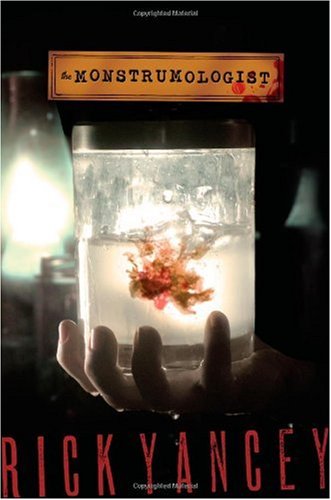
The Monstrumologist
by Rick Yancey
Michael L. Printz Honor Book 2010

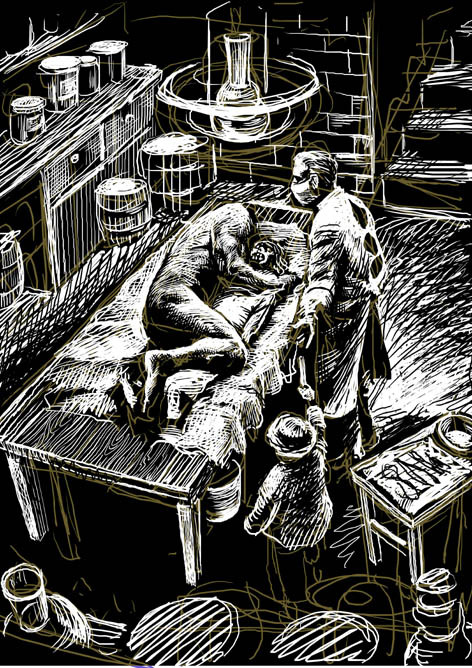
Every October, my book club tries to read a spooky YA book. Last year's selection was The Graveyard Book, so I suppose with that in mind, I can understand why other members of our group were expecting harmless ghouls to be the focus of Yancey's new work. Of course, they were terribly wrong, as the book is extremely graphic and reads somewhere between a penny-dreadful and 18th century Gothic literature. To give an example, the book begins with a vivid description of how an anthropophagus (the featured monster of the book) has not only eaten the corpse of a virginal girl, but impregnated it, as well. Worse, the anthropophagus fetus is still alive, so our twelve year old protagonist, Will Henry, must watch as his master, Dr. Pellinore Warthrop, aborts the abomination. This book is definitely not for the squeamish.

Will and the doctor spend the entirety of the novel trying to thwart other massacres at the claws of the anthropophagi, which we learn much later in the novel are in New England because of a failed experiment of Warthrop's father. Both Doctors Warthrop, as well as the characters of Dr. Starr and Jack Kearns, present various degrees of morality, and through them, one of the major themes of the work is explored: What makes a monster? Is a monster a creature of nightmare who feeds upon human flesh? Or can it be something more human? A man so dedicated to the pursuit of knowledge that he endangers innocents? Or a man who becomes his monstrous prey, no longer retaining any sense of compassion or empathy? Though Yancey never directs the reader's thoughts to any particular answer, the well-planned plot leads the reader to question the motives of all involved.

Presented as a journal compiled by Will later in life and given to the author, The Monstrumologist is written in a characteristically Victorian style, replete with verbose sentences spanning several lines of text and sundry literary allusions. For a reluctant reader, it may prove a bit challenging, but the subject matter and amount of gore should be enough to keep the attention of most. Being a fan of Victorian and Gothic literature, this book was a welcome change to much of the YA I have been reading recently, and I highly anticipate the next installment Curse of the Wendigo, which was released several weeks ago.

Grade: A+