Fire
by Kristin Cashore
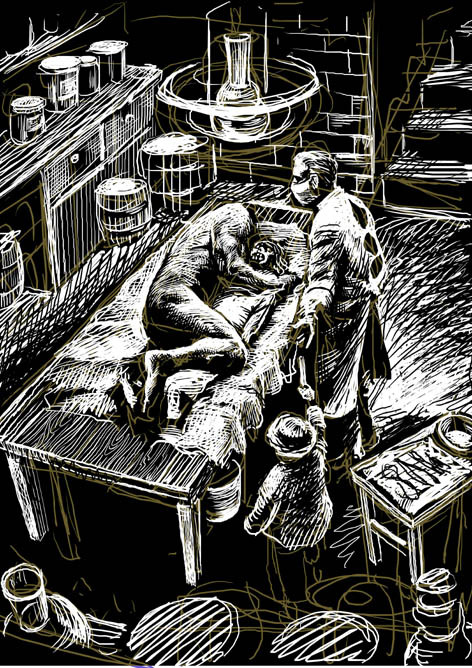
Set in the same world as Graceling thirty-five years earlier, Fire recounts the tale of the last human monster in the Dells. Though able to both read and control the thoughts of others, Fire chooses not to intrude upon the minds of those around her, using her powers only as a last resort in matters of self-defense. However, when two noblemen begin to plot against the king, the crown asks her to use her powers to aid in interrogating spies, and she eventually agrees to do so.
Like Katsa, Fire is a wonderfully written female protagonist. She fears becoming manipulative, as her father was, relishing her power over others. She yearns for children, but promises herself she won't bring any other monsters into the world. Though considered a monster because of her abilities, Fire's hopes and fears demonstate how very human she is.
While the story is derivative in some aspects, Ms. Cashore's brilliant characters manage to invigorate the story. I will admit I found the book a bit tedious at the beginning when Fire and her long-time friend Archer were the only major characters, as Archer's treatment of Fire bothered me, but once the plot moved into King's City and introduced the royal family, I felt the pace picked up significantly. My only other major complaint is with the final chapter's abrupt segue away from the climatic battle to a memorial service some time later. I would have liked to have read more about the battle, rather than to simply be told of its outcome in a few paragraphs. So much of the book built up to that moment that it was a bit of a let down to have so little time devoted to it.
All told, Fire proves to be an entertaining diversion, but I feel it did not quite live up to my expectations after having read its predecessor.
Grade: B+
Thursday, May 19, 2011
Sunday, May 15, 2011
"What an incomprehensible machine is Man!" -- Jean Nicolas Demeunier

The Astonishing Life of Octavian Nothing, Traitor to the Nation Vol. I & II
by M.T. Anderson
National Book Award 2006 (Vol. I), Printz Honor Book 2007 (Vol. I), Prinz Honor Book 2009 (Vol. II)
When I first read Octavian Nothing last year after receiving the books for Christmas, both volumes quickly became two of my favourite works for young adults (surpassed only by the His Dark Materials trilogy). In my book club, volume one had been nominated twice, losing both times by only one vote, before finally winning after its third nomination. I had been wanting to re-read the books for some time now, but book club gave me an excuse to put aside new books in order to do so.
The premise of the novel concerns a young boy, called Octavian, who is being raised by the Novanglian College of Lucidity in Boston in the years leading up to the Revolutionary War. His mother, Cassiopeia, claims to be a princess, and the boy is taught Greek, Latin, music, etc. as any child of the nobility might. Things are not as they seem, however, as Octavian and his mother are actually African slaves, and the boy is taught in the classical method as an experiment in which the collegians are attempting to determine if Africans are as mentally capable as their European counterparts.
After his mother rebuffs the sexual advances of a nobleman from whom the college hopes to receive investments, both she and Octavian lose many of their previous privileges, though Octavian's schooling does continue in part.
The latter half of the first volume and the entirety of the second detail Octavian's involvement in the Revolutionary War, first on the side of the rebels and later as a member of Lord Dunmore's Ethiopian Regiment. While the beginnings of Mr. Anderson's work asks its audience to question the so-called benevolence of the College, this latter half is even more philosophical, asking what liberty is and whether it can truly be bestowed upon humanity so long as governments exists.
An epistolary novel, both volumes are mainly comprised of the diary entries of Octavian Nothing, as well as various letters, advertisements, and other documents that aid the telling of his tale. As such, Mr. Anderson does a truly brilliant job making his audience believe that this journal was written in the 1700's, using archaic spelling and grammar. While this might cause the work to be viewed as difficult to the average teenage reader, I think Mr. Anderson should be commended for his authenticity, as well as for his historical accuracy.
Although such dense language often causes characterization to become lost in the mire, there is no such problem here. The characters are quite vividly portrayed, well thought-out, and, often, sympathetic. The language is such that one can genuinely feel the characters' doubts and hopelessness, as well as their joys. And, given its epistolary nature, I think this is a great accomplishment.
Grade: A+
Labels:
historical fiction,
M.T. Anderson,
National Book Award,
Printz Award,
YA
Saving the Monstrumologist

From Rick Yancey's Facebook: "I have just received word that the publisher of the series will NOT be renewing the contract for any future books after the release of Isle of Blood in September. Though the good folks at Simon & Schuster are quite proud, as I am, of the books’ critical success, sales simply have not been what either of us had hoped for. In short, the series is dead unless by some miracle sales of the books take off. I wanted to take this opportunity to publically thank S&S for believing in this project, my family for supporting me through the long nights and weekends while I struggled to “edit” Will Henry’s journals, and, of course, you, the fans of the series who have cheered for its success. I am very proud of you and very thankful that you came to share my passion for these characters and their world. I encourage you to share your passion with your friends and feel free to drop me a line here or at my website. If you are so inclined, you may contact the publisher at the link attached or write to it at Simon and Schuster Books for Young Readers, 1230 Avenue of the Americas, New York, NY 10020. Thanks again!"
When I read this on Friday, I was rather upset, as The Monstrumologist is one of my favourite series currently being written. I will definitely be writing to Simon & Schuster, and I encourage other fans to do the same. I understand that sales have not been as good as were expected, but I would think the publisher would wish to support a series that has done well critically. Despite this outcome, I hope that Mr. Yancey will continue to write The Monstrumologist series and that it may find a home elsewhere.
Those unfamiliar with The Monstrumologist series, can read my reviews for volume one here and for volume two here.
Monday, April 25, 2011
Unpolished Greenstone

Guardian of the Dead
by Karen Healey
Morris Debut finalist 2011
While attending boarding school (due to her parents' plans to travel around the world for a year), seventeen year-old Eleanor "Ellie" Spencer comes face to face with the myths of the Maori people. A black belt in tae kwon do, Ellie is asked by her best friend Kevin's friend, Iris, to teach some stage fighting to the cast of a student production of A Midsummer's Night Dream at a local university, which Iris is directing. When the girl playing Titania suddenly drops out of the production, Iris enlists the help of a bewitching specter of a woman, who takes more than a passing interest in Kevin.
Meanwhile, a series of grisly murders, collectively known as the Eyeslasher murders, have been perpetrated throughout the country, both on the north and south island. As Ellie begins to spend more time with mysterious day-student Mark Nolan, she realizes that the two seemingly disparate events may be related, and not only is her friend Kevin in danger, but the whole of New Zealand.
With so much of its plot steeped in Maori folklore, I was quite intrigued by the premise of Guardian of the Dead, as I was rather unfamiliar with Maori myth, but I was disappointed with the result. The first half of the book, which is about 180 pages, is well-written for a debut work. The tension between the characters builds as the chapters progress, and Reka, the mysterious woman, is rather unnerving. All of this, however, comes to little fruition as the second half unfolds, introducing a convoluted plot where the patupaiarehe (New Zealand's native fair-folk) attempt to gain immortality and reclaim their native land from the Western settlers.
My main complaint with the latter half is that the pace is so brisk that one has a difficult time keeping up with the myriad side characters that are introduced prior to the climactic battle for New Zealand. I would have preferred fewer characters that had been more developed. I also felt that a number of characters had a few enhancing details sprinkled on for flavour that neither added nor detracted from the story. Prof. Garibaldi, Ellie's classics teacher, is American (and, apparently, a magician), but it's never really explained why she's teaching in New Zealand. And Kevin's asexuality seems tacked on, a simple excuse for why he can't become Reka's consort.
Now, I will say that I liked Ellie. It's not every day that the protagonist is an overweight, comic-reading fan girl, so that was refreshing. She was the only character that was completely fleshed out, so I'm glad that she was likable.
All in all, Guardian of the Dead was an entertaining read, but there's not much else I can say about it. I'd be interested in seeing what else Ms. Healey produces, especially if she continues to polish her writing style, but I hope she waits until after finishing her dissertation, as her ideas deserve her full attention.
Grade: B-
Monday, April 18, 2011
Free to Be
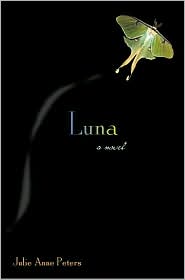
Luna
by Julie Anne Peters
National Book Award finalist 2004, Stonewall Honor Book 2005, Lambda Award finalist 2005
Regan's brother Liam has always been a bit different. His best friends have always been girls and he's always had an interest in fashion. His father suspects that he might be gay, but only Regan knows the truth. Liam is transgendered. Every night she keeps Regan up at odd hours while she dons her dresses, wigs, and make-up, permitting her true self, Luna, to emerge.
This novel is essentially the story of Luna's transition, as seen through Regan's eyes. Unfortunately, with its contemporary setting in the western United States, that story is not a very pleasant one. In addition to a male chauvisnist father and a pill-popping mother who refuse to accept the reality of the situation, Luna has to deal with the taunting of her classmates and local townspeople. With the lack of support and understanding presented to her, Luna contemplates suicide numerous times, and without Regan, who, despite her selfish wish that Luna was not so different, provides the only moral support in this difficult period of Luna's life, she may well have done more than contemplate.
Ms. Peters does a good job of explaining a complex and somewhat controversial topic in terms that a younger audience can understand, though I feel that the book would have been more powerful if told through Luna's point-of-view, rather than Regan's. The decision to use Regan as narrator has ensured that the audience remain outsiders incapable of understanding the problems of a transgendered youth first-hand. While Regan is sympathetic of Luna's plight, she can never truly understand the thought processes that go through Luna's mind, and thus, neither can the readers. True, some readers may be alienated by a book told from the perspective of a transgendered individual, but if so, this book was not written for them in the first place.
I found Regan to be a rather selfish character, more concerned with how her classmates and potential boyfriend would view her as Luna's sister than with how Luna was coping with her situation. Also, I felt that the characterization could have been stronger. Some aspects of the characters, such as their interests and hobbies, seemed like they were just tossed in as an after-thought. For example, Luna apparently is a manga fan, as exemplified by a scene in which her friend Aly returns a copy of Love Hina. But this interest is never explored, which makes me think the author was merely trying to retain the contemporary feel without any knowledge of the pop culture she mentions in passing.
Also, I realize that I am probably ridiculously naive and idealistic, but I seriously had to keep reminding myself that such biased individuals as Jack, the father of Regan and Luna, actually exist. I know that discrimination is still a major issue, especially in the transgender commmunity, but I can't fathom why. People are people. It's very simple. And we should all be free to live our lives however we may choose, provided that no one else is harmed.
I am glad this novel exists so that it might provide some understanding to people who otherwise might fear or mock transgendered people. While there were some minor flaws, I would still gladly recommend this novel.
Grade: A-
Labels:
Julie Anne Peters,
LGBT,
National Book Award,
slice-of-life,
YA
Subscribe to:
Posts (Atom)