Tuesday, November 16, 2010

Secret Identities


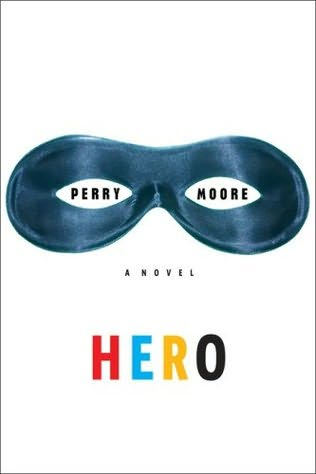
Hero
by Perry Moore
Lambda Literary Award for Children's & YA 2008


Thom Creed is every parent's dream child. He's the star of the basketball team, a good student, and the winner of a volunteer award for his work at a local youth center. He also has two rather large secrets: he has super-powers and he is gay. Add to the equation the fact that his father is a disgraced former superhero (he caused numerous civilian casualties in a World Trade Center type attack, where the terrorists were replaced by a planet-destroying alien) and you have the formula for a by-the-books coming-of-age novel with a few twists here and there.

When I first heard of Hero earlier this year after a member of my book club nominated it to be read, I was intrigued by the premise. I have always liked superhero fare, having grown up on Batman: The Animated Series and Justice League, and I was sold on the gay perspective. However, once I borrowed a copy from my local library, I was quickly disappointed, as it simply did not live up to my expectations. To begin with, the writing was very uneven. I realize that this was Moore's first novel, and as such, it may not be as polished as other works that I have read recently, but I seriously have to wonder if he had an editor. I frequently noticed typos (the worst being when an exclamation point was incorrectly referred to as an explanation point), and there seemed to be some inconsistencies (at one point Thom encounters a group of villains he's never seen or heard of, but they are all referred to by name in the narration). To be perfectly honest, I considered putting this book aside after the first fifty or so pages, but I kept chugging along because of its award.

I am glad I kept reading, as the last third of the book is much tighter than the other two-thirds and the world destruction plot was interesting. This is not to say it was original, though, as I figured out most of what would happen long before it did, from the identity of Dark Hero to that of the assassin haunting the league. The characters were likable, but generic, and I found the bigotry against Thom to be a little unbelievable. Taunts from peers made sense, but graffiti on his house? The latter certainly never happened to my gay friends, and we lived in a pretty conservative town.

All in all, Hero is something to recommend to nerdy teens who might otherwise have no fictional GLBT role-model, and it's a decent effort for a first-time author.

Grade: C+

Wednesday, November 10, 2010

What Makes the Monster?


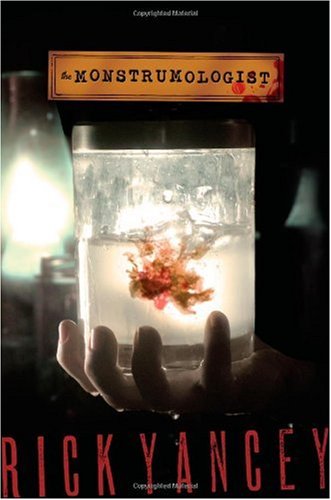
The Monstrumologist
by Rick Yancey
Michael L. Printz Honor Book 2010

Every October, my book club tries to read a spooky YA book. Last year's selection was The Graveyard Book, so I suppose with that in mind, I can understand why other members of our group were expecting harmless ghouls to be the focus of Yancey's new work. Of course, they were terribly wrong, as the book is extremely graphic and reads somewhere between a penny-dreadful and 18th century Gothic literature. To give an example, the book begins with a vivid description of how an anthropophagus (the featured monster of the book) has not only eaten the corpse of a virginal girl, but impregnated it, as well. Worse, the anthropophagus fetus is still alive, so our twelve year old protagonist, Will Henry, must watch as his master, Dr. Pellinore Warthrop, aborts the abomination. This book is definitely not for the squeamish.

Will and the doctor spend the entirety of the novel trying to thwart other massacres at the claws of the anthropophagi, which we learn much later in the novel are in New England because of a failed experiment of Warthrop's father. Both Doctors Warthrop, as well as the characters of Dr. Starr and Jack Kearns, present various degrees of morality, and through them, one of the major themes of the work is explored: What makes a monster? Is a monster a creature of nightmare who feeds upon human flesh? Or can it be something more human? A man so dedicated to the pursuit of knowledge that he endangers innocents? Or a man who becomes his monstrous prey, no longer retaining any sense of compassion or empathy? Though Yancey never directs the reader's thoughts to any particular answer, the well-planned plot leads the reader to question the motives of all involved.

Presented as a journal compiled by Will later in life and given to the author, The Monstrumologist is written in a characteristically Victorian style, replete with verbose sentences spanning several lines of text and sundry literary allusions. For a reluctant reader, it may prove a bit challenging, but the subject matter and amount of gore should be enough to keep the attention of most. Being a fan of Victorian and Gothic literature, this book was a welcome change to much of the YA I have been reading recently, and I highly anticipate the next installment Curse of the Wendigo, which was released several weeks ago.

Grade: A+

Thursday, November 4, 2010

Battle Royale Revisited?

*A Note*
Starting with this entry, all books reviewed will be given a letter grade to make my opinion more clear. Older entries have been graded retroactively.
****

The Hunger Games Trilogy
by Suzanne Collins
Consisting of: The Hunger Games, Catching Fire, and Mockingjay

Thanks to a friend loaning me all three of Suzanne Collins's Hunger Games trilogy, I can finally join the rest of the YA-reading world in my frustration with the final book. I am, however, glad that I waited to read the series until it was released in its entirety, as I would not have been able to stand the wait between books. That said, I completed the entire trilogy within several days' time, thanks to a short trip back home for an interview.


For those of you living under a rock, Hunger Games tells the story of Katniss Everdeen, a girl chosen to participate in an annual competition where youths aged twelve to eighteen must kill each other for survival. The games, we are told, are used to punish the twelve districts of Panem (a country replacing what remains of the US in the near-future) for an uprising that took place seventy-four years ago. So each year, two teens (a boy and a girl) are drawn at random from each district. People may volunteer to take the place of the randomly chosen, as Katniss volunteers to go, in order to save her twelve year old sister.

The remainder of the first book focuses on the events of the games themselves, and as Katniss is our narrator, we know only what she knows. At times, this can be frustrating, as she spends much of the first few days simply distancing herself from the other competitors. Eventually, she makes a few strategic alliances and wins the game. The two remaining books detail the new uprising in the districts and Katniss's integral role in the revolt against the capital.

As I've already complained, the choice to use Katniss as the narrator is problematic at times, especially in later books, as she is frequently kept in the dark about various plans until they are executed. What makes this choice worse is that Katniss is not a very likable character. She's cold, distant, and self-serving; ideal qualities for someone competing in the games, I suppose, but not for the protagonist of a trilogy.

The writing is rather brusque, which suits our narrator perfectly, but does not often provide adequate detail for my tastes. Some passages become especially muddled in the last book during battle scenes, and the death scenes of several major characters left much to be desired. One would think that after spending three books becoming attached to a character that they would be granted more than a few meager sentences! Additionally, the latter two-thirds of the last book are incredibly rushed; I would have liked a more even pace, though I understand that it may have been intentional, as one does not have time to collect thoughts on the battlefield.

I also really would have liked more information on the history of Panem. We are never told what led to the destruction of the US as we knew it. Why did the capital move to Denver (We are told it's a major city in the Rockies, which leads me to think of the Colorado capital)? Did the religious right finally attempt to secede from the union, ultimately destroying our nation? Or was it terrorism that brought about our demise? I am truly hoping that in the film adaptation, Collins gives us more information on the world she's created.

All in all, I can easily understand why the trilogy is so popular right now. It's a great read with some truly interesting ideas about revolution and society, even if those ideas could have been expanded upon. Go read it before the films are released.

Series Grade: A

Wednesday, October 6, 2010

Parsley, Sage, Rosemary, and Thyme


Impossible
by Nancy Werlin

Imagine if the lyrics to a popular song were not merely poetic words set to music, but a list of tasks one must complete or risk going mad. This is the main premise of Werlin's book Impossible in which seventeen year old Lucy Scarborough, a perfectly rational girl, is told that she must complete the impossible tasks described in a version of the ballad "Scarborough Fair" before giving birth to her child (I should mention here that at the beginning of the novel she has no boyfriend and is a virgin). Having been raised by foster parents after her biological mother became mentally ill and took to a life in the streets, when Lucy first learns of the ballad and the tasks, she dismisses it as nonsense. However, after a bizarre turn of events on prom night leads to Lucy's becoming pregnant, she begins to reconsider, and, ultimately, pursues the accomplishment of the tasks after learning that all of her family records indicate that generations of women in her family have given birth at seventeen and descended into madness.

When I first read the premise, I found myself thinking it sounded a bit far-fetched, but Werlin tells it as a modern fairy tale, and I found myself completely immersed within the first few chapters. The characters are also all very likable, so it was easy for me to invest myself in them and their plight; I wanted them very much to succeed. And just as much as Lucy and her family are likable, the antagonist, Padraig Seeley is just as detestable. He is exactly as Sidhean in the previously reviewed Ash should have been: calculating, cold, and merciless.

Something I found particularly refreshing was that despite the presence of magic, curses, and the faerie realm, the mundane characters did not rely on magic, but rather science and logic to break Padraig's curse. Additionally, this helped to reinforce the modern setting of the novel, replete with medical records and a healthy dose of skepticism.

My only complaint is that some of the events, especially the ending, are a bit too neat for my liking. The presence of the boy-next-door, Zach, is all too convenient for the necessary romance of the novel, and as much as I (and probably most of the novel's target audience) like him, I seriously have to question how quickly he and Lucy not only realized their feelings for each other, but acted upon them. For a novel that otherwise asked its audience to be rational, I found this to be a bit off-base.

Grade: B+

Monday, October 4, 2010

The Girl Who Cried Wolf


Liar
by Justine Larbalestier

Let me start by stating this is not the type of book I would normally enjoy. Written in colloquial speech (here an inner-city teen) and presented as a direct confession to the reader, the writing is far from the eloquent prose that I am accustomed to typically reading. However, the story is so well-constructed that I barely even noticed.

The premise is quite simple: Micah, our narrator/confessor, has been accused of murdering Zach, the most popular boy in school. At first, we are told that they were only classmates, but over time it is revealed that not only were they friends, but they also shared a secret love affair, though Micah consistently denies this when pressed by her parents, counselors, and Zach's girlfriend, Sarah. We, the readers, are the only ones meant to know the entire truth, which is given to us in snippets, as the narrative goes back and forth from before and after the murder.

Things are not entirely clear-cut, however, as we're told from the beginning that Micah is known for her lies. On her first day of high school, she claims to be a boy, and when it is discovered that she is a girl, she says instead that she is intersex. She also tells her classmates that her father is an arms dealer, among other things. Knowing her character, it becomes difficult for the reader to believe her story, especially as it becomes increasingly far-fetched. I won't say much about what is revealed later, though I will state that it involves the supernatural.

By the end of the book, I was entirely unsure what to believe. Was Micah simply spinning an elaborate lie? Or did all of this really happen, regardless of how fantastic it might seem? I believe this uncertainty is a testament to Larbalestier's ability to create a truly unreliable narrator, which she succeeded in so doing brilliantly, and it is for that reason alone that I must recommend this book.

Grade: A-