I realize this is a week late. Apparently, my school reading is going to be a bit more time-consuming than expected this semester. I'll try to do better about posting over the weekend, but no guarantees.
Title: Hatchet
Author: Gary Paulsen
Publishing Date: 1987
Reason Read: required for YA Resources (previously read in 6th grade)
Awards: Newbery Honor 1988
I remember reading Hatchet for my 6th grade English class and hating it, so when it was on the syllabus for my YA Resources class, I cringed a bit, but decided that as an adult maybe I'd better enjoy the book. I was wrong.
The story of Brian, a thirteen year old who survives a plane crash after the pilot of the single-engine plane has a heart attack, has the potential to be captivating, but not enough details of Brian's civilian life are given. All we are told is that his parents are divorced, and Brian unwittingly was privy to the reason why: his mother's illicit affair. Additionally, the writing is extremely repetitive, using the same words and phrasing ad nauseum to the point where I questioned if Mr. Paulsen owned a thesaurus. I understand that the writing is meant to mimic Brian's thoughts, but I'd like to think that even a teenager lost in the wilderness is a bit more sophisticated than this.
Grade: C
Title: Annie on My Mind
Author: Nancy Garden
Publishing Date: 1982
Reason Read: required reading for YA Resources
Awards: N/A
The quintessential lesbian romance novel for young adults, Annie on My Mind tells the story of two New York girls, Annie and Liza, who have a chance meeting at the Metropolitan Museum of Art. The girls quickly become best friends, and the relationship evolves into something more.
Although this novel was written thirty years ago, it is still as poignant and believable today. While Annie has acknowledged that she is gay for some time, Liza's feelings are frightening and new, and she struggles to come to terms with them, as so many others do. And on top of the main romance plot, there is a major plot point involving two teachers at Liza's school who are lesbians and how the school administration reacts to this. While the acceptance of gays has certainly made strides since 1982, the events that unfold in this novel are still extremely plausible, especially in more conservative parts of the country. Highly recommended for any girl questioning her sexuality.
Grade: A
Title: Weetzie Bat
Author: Francesca Lia Block
Publishing Date: 1989
Reason Read: required reading for YA Resources
Awards: Phoenix Award 2009
Despite being only slightly longer than 100 pages, Weetzie Bat manages to cram non-traditional families, gay relationships, and AIDS in its plot without weakening it. Often described as a pop fairy tale, the story follows teenage Weetzie, her friend Dirk, and the life they build through the results of three wishes Weetzie makes via a genie in a magic lamp. I suppose it's a bit precious, but the writing is so ethereal and poetic, I found myself easily sucked into the story. My only real complaint is that more time is spent on surface details instead of building really deep characters, but that goes along with the fairy tale concept, as do the bizarre names (i.e. My Secret Agent Lover Man).
Grade: A-
Title: Monster
Author: Walter Dean Myers
Publishing Date: 1999
Reason Read: required reading for YA Resources
Awards: National Book Award finalist 1999, Printz Award 2000, Coretta Scott King Honor 2000
Written as a screenplay by the main character, Steven Harmon, Monster is a courtroom drama concerning a murder trial of a convenience store owner in New York City. While we are told that Steve served as a look-out of sorts, checking to see that no customers were in the store prior to the botched robbery, throughout the course of the trial, the defense tries to prove his innocence and save Steve from a life behind bars. A number of witnesses are criminals themselves, somewhat discrediting the case of the prosecution. And the entire trial both the jury and we the readers are left wondering if Steve is really innocent.
Given Steve's penchant for filmmaking, the screenplay concept is a nice touch. Had Mr. Myers chosen to write in a traditional format, the story easily could have become bogged down with legal jargon, but as a quick-moving screenplay, such terminology is dealt with much more easily. That the format fits the character so well is a credit to the author.
Grade: A
Title: The Perks of Being a Wallflower
Author: Stephen Chbosky
Publishing Date: 1999
Reason Read: required reading for YA Resources (previously read senior year of high school)
Awards: N/A
Maybe this was just something we did at my high school, but I remember reading Perks in my senior year and passing the copy around to people and having them leave comments in the margins. My own copy was just between my best friend (now husband) and myself, but I had friends who also did this with larger groups of friends. I think the epistolary format and confessional tone of the letters is conducive to this.
I think I'm a bit biased toward this book, not only because of how nostalgic it makes me feel, having grown up in the 90's and come of age soon after the millennium, but also because the book is set in the Greater Pittsburgh metro area. All the places that are mentioned in this book are familiar to me, so it ends up having a special place in my ya collection.
Despite this personal connection to Mr. Chbosky's novel, the issues presented, including homosexuality, teen pregnancy, and abuse are rather universal issues faced by teenagers everywhere, which is why it's such an appealing book. I truly feel that it's my generation's Catcher in the Rye.
Grade: A
Title: Gossip Girl
Author: Cecily von Ziegesar
Publishing Date: 2002
Reason Read: required reading for YA Resources
Awards: N/A
By far the worst book I've read in some time, Gossip Girl is about as mindless as I expected it to be. And while the writing is decent, at least if one likes the style used in gossip columns, what really irritated me was that the characters are almost described in terms of what brand-name they are wearing. If one has no concept of what a certain Prada dress looks like, he'll have little idea what to visualize.
Even worse than the lack of poetic description is the sheer lack of positive characters in the main cast. Nearly all of the major characters drink, smoke, and do recreational drugs. The only girl at the school that I can tolerate is the artistic misfit, Vanessa, but aside from attending a concert with the flighty Serena, she's a peripheral character at best.
I'm glad that these books are getting teens reading, I suppose, but there's so much wrong with them that I really worry about the negative influence the books could potentially have on young readers.
Grade: C-
Showing posts with label National Book Award. Show all posts
Sunday, January 15, 2012
Friday, December 30, 2011
The Witch-queen of Swampsea
Chime
by Franny Billingsley
National Book Award finalist 2011
Set in turn-of-the-century England, Chime recounts the story of teenage Briony, a self-effacing girl who claims to be a witch. In the first few sentences of the novel, she claims also to be a murderer, blaming herself for the swamp sickness that has claimed the lives of numerous townspeople, as well as the death of her step-mother. Her twin sister, Rose, who appears to be autistic but is never described as such, is also a major cause of Briony's self-loathing, as the girl again blames herself for her sister's condition. Due to the great amount of self-hatred depicted, I a number of people at my book club had difficulty slogging through this book, but it definitely pays off in the end.
While this novel definitely has elements of fantasy with various swamp spirits playing key roles in the plot, it often doesn't read like a fantasy novel, leaving several of my colleagues confused as to whether Briony was hallucinating or actually experiencing the various events involving the spirits. This uncertainty is probably the only qualm I had with the book, overall. The prose is usually rather elegant, indicative of Briony's class and her love of writing, and the story blends fantastic elements with reality rather well. The love interest, Eldric, is quite likeable, as are Rose and Briony. But, despite all its positive factors, Chime just didn't stick with me. I may well read it again someday, but I found myself really having to cull through my memory just to write this short review, and I know a friend of mine felt the same way.
Of the finalists for the National Book Award, this and Okay for Now are definitely my preferred titles; however, none of the nominees really jumped out at me as titles that will become canonized. Time will tell, I suppose.
Grade: B+
Sunday, December 4, 2011
Luke Aaluk's School Days
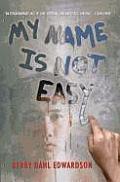
My Name Is Not Easy
by Debby Dahl Edwardson
National Book Award finalist 2011
In the 1960's, an Inupiaq (Eskimo) boy called Luke, whose real name is too difficult to for non-Inupiaq to pronounce, is sent to a Catholic boarding school, along with his two younger brothers, to complete his education. The majority of the students are other Inupiaq kids and kids from the Athabascan tribe, and the two groups do not get along. Speaking their tribal languages is forbidden, and the boys find it difficult to live under the guidelines imposed by the strict Catholic faculty.
While the subject matter is interesting, primarily because there is little fiction pertaining to Native Alaskan matters, and I certainly learned a decent amount about various real-life incidents like the Duck-In and iondine-131 testing among students, I found the writing to be distracting and a bit sloppy. At the beginning of each chapter, Ms. Edwardson would note the character upon whom the chapter would focus, but the POV for specific characters would shift throughout the book. For example, the majority of Luke-focused chapters would be written in first-person through his perspective; however, near the end of the book a clearly marked Luke chapter is written in third-person for no apparent reason. This happens with a few other characters, as well.
Also, since there's no over-arching plot, the book reads more like a series of school vignettes. Unfortunately, this has a negative effect upon readers' emotional connection to the characters, so when dramatic events take place, such events did not have the impact they might have had with a better writer.
My Name Is Not Easy is the second National Book Award finalist that I have had qualms about. It, and the previously reviewed Inside Out and Back Again both seem, to me at least, to have been nominated because of their diverse subject matter alone, and not because of the strength of their writing or expected longevity.
Grade: B-
Saturday, November 19, 2011
From Saigon to Alabama
Inside Out and Back Again
by Thanhha Lai
National Book Award 2011
In 1975, young Ha and her family are scraping by in Saigon, waiting for her father, a naval officer, to return. When the family learns that South Vietnam will soon fall to the communists, however, Ha's mother makes the difficult choice to flee. Crammed onto a boat with hundreds of other families, Ha and her family decide to go to America, where they are sponsored by a man in Alabama.
While the book is divided into thematic sections -- Saigon, the boat, and America -- the American section is definitely the longest and one of the more emotional sections, as Lai details Ha's attempts to fit in at school and in the community. Aside from a neighbor who happens to be a retired teacher who helps Ha with her English, there are few likeable American characters. It is unclear if this was intentional in order for readers to better sympathize with the Vietnamese protagonists or if it is factual, as Ms. Lai based a number of events on her own childhood in the South.
Given the subject matter, I had expected the book to be far more emotional. Perhaps it is because the verse prevents any major character depth or analysis, but I felt rather disconnected throughout its duration. I'm glad that there is a children's book about the fall of Saigon written through the POV of a Vietnamese child, but I feel like this book, at least, is more focused on America and assimilation. It's a worthy attempt, but it falls short.
Grade: B
Labels:
children's,
historical fiction,
National Book Award,
poetry,
Thanhha Lai
Friday, October 28, 2011
Good Kids Can Have Bad Records
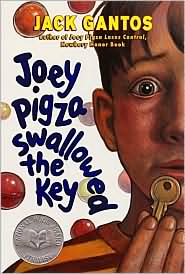
Joey Pigza Swallowed the Key
by Jack Gantos
National Book Award finalist 1998
Joey Pigza is a good kid. This is apparent to his teachers, but often obscured by his uncontrolled ADHD. When he accidentally injures another student, however, the school can no longer stand idly by; Joey must be sent to the local special education center until he can keep his disorder properly checked.
While some of the handling of ADHD is a bit dated now (given that there are more treatment options than Ritalin), this is still a fabulous book on the issue. Mr. Gantos writes in a first-person, almost stream-of-consciousness style to emulate Joey's thought processes, which provides great insight into the mind of a young boy with this disorder. Joey himself also learns tolerance for those with mental and physical disabilities through his interactions with other children at the special education center, befriending a boy with malformed arms and another who is developmentally disabled.
Those interested in continuing to follow Joey's exploits should check out the other books in the series, starting with the next installment, Joey Pigza Loses Control.
Grade: A-
by Jack Gantos
National Book Award finalist 1998
Joey Pigza is a good kid. This is apparent to his teachers, but often obscured by his uncontrolled ADHD. When he accidentally injures another student, however, the school can no longer stand idly by; Joey must be sent to the local special education center until he can keep his disorder properly checked.
While some of the handling of ADHD is a bit dated now (given that there are more treatment options than Ritalin), this is still a fabulous book on the issue. Mr. Gantos writes in a first-person, almost stream-of-consciousness style to emulate Joey's thought processes, which provides great insight into the mind of a young boy with this disorder. Joey himself also learns tolerance for those with mental and physical disabilities through his interactions with other children at the special education center, befriending a boy with malformed arms and another who is developmentally disabled.
Those interested in continuing to follow Joey's exploits should check out the other books in the series, starting with the next installment, Joey Pigza Loses Control.
Grade: A-
Labels:
children's,
Jack Gantos,
National Book Award,
slice-of-life
Friday, September 23, 2011
New Town, New Possibilities
Okay for Now
by Gary D. Schmidt
National Book Award finalist 2011
The late 60's were a difficult time in which to grow up. Civil rights, the Vietnam War, the assassination of Robert Kennedy...These all made it increasingly difficult to navigate through childhood and adolescence. For Mr. Schmidt's protagonist, Doug Swieteck, add in being the new kid in town, and having an alcoholic father and a brother newly returned from the war. Life is far from easy for Doug.
After a local store is robbed (and the younger of Doug's two older brothers is suspected), Doug is either treated with contempt or ignored completely by his fellow classmates, teachers, and townspeople. The only people who give him a chance are Mr. Powell, the local librarian, and Lil Spicer, the daughter of the local grocer for whom Doug works as a delivery boy. Throughout the book, Doug's moods fluctuate wildly, depending on how he's being treated, which I found to be extremely realistic.
The other major story thread throughout the book concerns a copy of Audobon's bird prints, which are being auctioned off one by one to fund the library. As Doug learns how to draw with Mr. Powell each Saturday, copying the Audobon prints, he gradually becomes attached to the pieces and begins a crusade to return the sold prints to the library. In an age where government funding of libraries is being significantly decreased, as law-makers question the role of libraries in this digital age, it was wonderful to see Mr. Schmidt portray the library as a place of learning, and also for him to promote advocacy.
What I was probably most impressed with was Mr. Schmidt's ability to convey a broad range of emotions through simple text. Since our protagonist begins the book as an illiterate, the sentences are succinct and usually devoid of adjectives, yet they never seem to condescend to the intended audience.
There's a lot of buzz about this book at present, and a good many people are predicting a Newbery. I haven't read the other books that people are predicting will be nominated, so I can't say for certain if Okay for Now will win, but I can say that it's well worth a look.
Grade: A
P.S. I still don't know why the cover depicts a boy with a paper bag over his head.
Sunday, May 15, 2011
"What an incomprehensible machine is Man!" -- Jean Nicolas Demeunier

The Astonishing Life of Octavian Nothing, Traitor to the Nation Vol. I & II
by M.T. Anderson
National Book Award 2006 (Vol. I), Printz Honor Book 2007 (Vol. I), Prinz Honor Book 2009 (Vol. II)
When I first read Octavian Nothing last year after receiving the books for Christmas, both volumes quickly became two of my favourite works for young adults (surpassed only by the His Dark Materials trilogy). In my book club, volume one had been nominated twice, losing both times by only one vote, before finally winning after its third nomination. I had been wanting to re-read the books for some time now, but book club gave me an excuse to put aside new books in order to do so.
The premise of the novel concerns a young boy, called Octavian, who is being raised by the Novanglian College of Lucidity in Boston in the years leading up to the Revolutionary War. His mother, Cassiopeia, claims to be a princess, and the boy is taught Greek, Latin, music, etc. as any child of the nobility might. Things are not as they seem, however, as Octavian and his mother are actually African slaves, and the boy is taught in the classical method as an experiment in which the collegians are attempting to determine if Africans are as mentally capable as their European counterparts.
After his mother rebuffs the sexual advances of a nobleman from whom the college hopes to receive investments, both she and Octavian lose many of their previous privileges, though Octavian's schooling does continue in part.
The latter half of the first volume and the entirety of the second detail Octavian's involvement in the Revolutionary War, first on the side of the rebels and later as a member of Lord Dunmore's Ethiopian Regiment. While the beginnings of Mr. Anderson's work asks its audience to question the so-called benevolence of the College, this latter half is even more philosophical, asking what liberty is and whether it can truly be bestowed upon humanity so long as governments exists.
An epistolary novel, both volumes are mainly comprised of the diary entries of Octavian Nothing, as well as various letters, advertisements, and other documents that aid the telling of his tale. As such, Mr. Anderson does a truly brilliant job making his audience believe that this journal was written in the 1700's, using archaic spelling and grammar. While this might cause the work to be viewed as difficult to the average teenage reader, I think Mr. Anderson should be commended for his authenticity, as well as for his historical accuracy.
Although such dense language often causes characterization to become lost in the mire, there is no such problem here. The characters are quite vividly portrayed, well thought-out, and, often, sympathetic. The language is such that one can genuinely feel the characters' doubts and hopelessness, as well as their joys. And, given its epistolary nature, I think this is a great accomplishment.
Grade: A+
Labels:
historical fiction,
M.T. Anderson,
National Book Award,
Printz Award,
YA
Monday, April 18, 2011
Free to Be
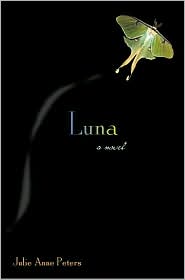
Luna
by Julie Anne Peters
National Book Award finalist 2004, Stonewall Honor Book 2005, Lambda Award finalist 2005
Regan's brother Liam has always been a bit different. His best friends have always been girls and he's always had an interest in fashion. His father suspects that he might be gay, but only Regan knows the truth. Liam is transgendered. Every night she keeps Regan up at odd hours while she dons her dresses, wigs, and make-up, permitting her true self, Luna, to emerge.
This novel is essentially the story of Luna's transition, as seen through Regan's eyes. Unfortunately, with its contemporary setting in the western United States, that story is not a very pleasant one. In addition to a male chauvisnist father and a pill-popping mother who refuse to accept the reality of the situation, Luna has to deal with the taunting of her classmates and local townspeople. With the lack of support and understanding presented to her, Luna contemplates suicide numerous times, and without Regan, who, despite her selfish wish that Luna was not so different, provides the only moral support in this difficult period of Luna's life, she may well have done more than contemplate.
Ms. Peters does a good job of explaining a complex and somewhat controversial topic in terms that a younger audience can understand, though I feel that the book would have been more powerful if told through Luna's point-of-view, rather than Regan's. The decision to use Regan as narrator has ensured that the audience remain outsiders incapable of understanding the problems of a transgendered youth first-hand. While Regan is sympathetic of Luna's plight, she can never truly understand the thought processes that go through Luna's mind, and thus, neither can the readers. True, some readers may be alienated by a book told from the perspective of a transgendered individual, but if so, this book was not written for them in the first place.
I found Regan to be a rather selfish character, more concerned with how her classmates and potential boyfriend would view her as Luna's sister than with how Luna was coping with her situation. Also, I felt that the characterization could have been stronger. Some aspects of the characters, such as their interests and hobbies, seemed like they were just tossed in as an after-thought. For example, Luna apparently is a manga fan, as exemplified by a scene in which her friend Aly returns a copy of Love Hina. But this interest is never explored, which makes me think the author was merely trying to retain the contemporary feel without any knowledge of the pop culture she mentions in passing.
Also, I realize that I am probably ridiculously naive and idealistic, but I seriously had to keep reminding myself that such biased individuals as Jack, the father of Regan and Luna, actually exist. I know that discrimination is still a major issue, especially in the transgender commmunity, but I can't fathom why. People are people. It's very simple. And we should all be free to live our lives however we may choose, provided that no one else is harmed.
I am glad this novel exists so that it might provide some understanding to people who otherwise might fear or mock transgendered people. While there were some minor flaws, I would still gladly recommend this novel.
Grade: A-
Labels:
Julie Anne Peters,
LGBT,
National Book Award,
slice-of-life,
YA
Sunday, April 3, 2011
Reconciling Religion and Science
Charles and Emma: The Darwins' Leap of Faith
by Deborah Heiligman
National Book Award finalist 2009, Printz Honor 2010
I would like to preface this review with two statements. Firstly, I don't typically read non-fiction, so I may not be judging this work by the same criteria as one more familiar with non-fiction writing. In fact, I think the only other non-fiction work I've read in the past several years has been Erik Larson's The Devil in the White City, which I absolutely loved.
Second, since this book has a good deal to do with religion, I want my audience to be aware of my own views, which I hope won't colour this review too much. I am first and foremost a humanist, and I would also consider myself an agnostic. I feel that people are free to believe and practice religion however they choose to do so, as long as they are respectful of other people's belief systems and are not harming anyone or anything. Any comment bashing my beliefs will be deleted.
Rather than focus the entire book on an explanation of Darwin's famous evolutionary theory and how he formulated it, Ms. Heiligman instead chooses to focus on the relationship between Darwin and his wife Emma, as well as their opposing religious views. Despite having studied theology at college, as Darwin devotes more time to understanding the theory he is concocting, he begins to doubt God's part in creation more and more. This greatly concerns his religious wife, as she fears that they will be parted after death, and she often entreats him to reconsider his religious views. What I personally found to be particularly interesting was Darwin's fear that his work would offend religous parties. As such, he would ask his wife's opinion before publishing his various scientific works and would alter certain passages if she so recommended. This was extremely refreshing to me, given how hostile the religious can be to the secular and vice versa in our current society.
As someone who doesn't particularly like reading non-fiction, the focus on character made the book more enjoyable for me than it otherwise might have been, as it reads more like a romance than a biography. I also felt that the work handled the religious question extremely well without catering too much to the secular or to the religious, presenting both Charles's and Emma's perspectives clearly. For the most part, the narrative moves at a good pace, though there was never a moment when I forgot that I was reading non-fiction. Ms. Heiligman presents a captivating new look at a brilliant scientist, and I encourage people of all philosophies to give it a look.
Grade: A-
Labels:
Deborah Heiligman,
National Book Award,
non-fiction,
Printz Award,
YA
Wednesday, March 23, 2011
Disbanding the Boys' Club

The Disreputable History of Frankie Landau-Banks
by E. Lockhart
National Book Award finalist 2008, Printz Honor Book 2008
The titular Frankie Landau-Banks is a devious mastermind behind a semester's worth of pranks carried out by secret societ the Loyal Order of the Basset Hounds. Vaguely familiar with the Order, as her father was a member during his school days, and inspired by the Cacophony Society after doing a project about them for one of her classes, Frankie decides to turn the orderly world of her prep school on its ear, including the boys-only Basset Hounds.
As per usual, this book had been on my "want to read" list for a while, but it was book club that provided the impetus for me to finally do so. While I have read some reviews complaining that the writing could be overly pretentious at times, I found the writing to be one of the novel's greatest strengths. Though at the beginning the novel occasionally fell into the frame of the typical teen romance novel, I appreciated that Ms. Lockhart was confident enough in her readers' intelligence that she devoted an entire chapter to false positives, both real and imagined. I suppose such chapters, as well as the references to the panopticon, are why some view this work to be pretentious.
I didn't find Frankie to be a likeable character, and I could not relate in any way to her desire to break the rules. I also was somewhat disappointed that the novel seemed to assert that those women who choose to engage in feminine activities were doing so only to appear to the men in their lives to be proper women. I certainly shall never deny that a number of women do dress certain ways or, for example, pretend to be less intelligent than they actually are, to attract men. However, to conclude that there is little, if any, personal enjoyment to be found in feminine activities bothered me. In my frilly Victorian-esque dresses, I suppose I appear to most like a lost Disney princess a la Enchanted, but I choose to be this way for no one save myself. I wonder what Frankie would think of such individuals, as she seemed to have such disdain for the other female characters in the book.
While I can understand her desire to be involved in the same activities as the boys, I really felt that she only wanted to be involved in order to assert her superiority over them. She criticized Matthew for keeping secrets from her and for treating her like a pet, but she didn't seem to have much respect for Matthew as a person either. Her interest seemed purely superficial to me, which is probably why I found her so hard to like. I hated her double standards.
Despite my disagreement with the author as stated above and my difficulties with Frankie, I highly recommend this book. Girls should read it for its empowering message (even in the guise of the misguided protagonist), and boys should do so to better understand the obstacles that still impede women from being true equals with men even now.
Grade: A-
Labels:
E. Lockhart,
National Book Award,
Printz Award,
slice-of-life,
YA
Thursday, November 18, 2010
Losing My Religion
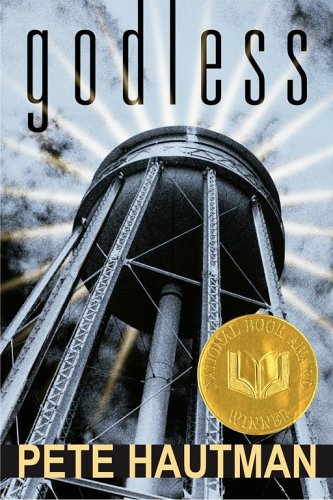
Godless
by Pete Hautman
National Book Award for Young People's Literature 2004
Religion is a very difficult issue to discuss. Questioning religion, which is the main premise of Hautman's Godless, is even more difficult to present well, especially to a young audience. Through the agnostic-leaning-toward-atheist protagonist Jason, the author asks all the right questions pertaining to faith and religion, though none are answered by the novel's end. This is, perhaps, a wise decision, as it permits the audience to decide for themselves whether or not to believe in any given religion, thus enabling the author to present occasionally negative views on organized religion without leading the reader to accept them.
After Jason concocts the idea to create a religion centering around the town's water tower, he recruits his friends to join his newly founded faith. For the most part, the kids regard the whole enterprise as a goofy activity that keeps them from complete boredom. However, Jason's best friend, Shin, becomes totally engaged with the concept, even going so far as to write a holy book to accompany their new religion (the excerpts from which become the headers of each chapter, typically paralleling the events described therein). As a foil to Shin's religious fanaticism, we have the town bully Henry, who uses "Chutengodianism" as an excuse to vandalize public property and dictate the actions of his friends. I must say I was happy to see so many variations of religious experience within the novel, and the portrayal of Just Al, the leader of the Catholic youth group Jason is forced to attend, was spot-on in his blind faith.
I have to admit, though, I'm a bit puzzled as to why this particular work won the National Book Award. It was certainly engaging, and it posed all of the right questions, but it just didn't have much impact. Maybe Octavian Nothing spoiled me, but I was just expecting more from a novel that won such a prestigious award.
Grade: A-
Subscribe to:
Posts (Atom)